Friday, May 17, 2013

Fake Friends

Some of us (myself included) aren't doing our homework.

I've been on Facebook for seven years now, and in that time I've managed to get connected to 370 friends.  Call me old fashioned, but I figure I should at least know someone - or know of them - if I'm going to let them into my Face World. Up until recently that's been my standard, and though it's left me with a rather humble friend count, (given the time frame), I don't have to worry about any of them violating my trust or causing me any sort of cyber-grief.

Lately, however, I've let my guard down a couple of times. Maybe it's because I am, after all, somewhat prone to Friend-Count Anxiety Disorder, or maybe like most of us, I love it when someone young and attractive wants to be my friend.  Either way, my recent lower standard for friend acceptance was based on whether or not the request came from someone who was already friends with the people in my existing network. I was making an assumption that these folks had already done the vetting.  But I was mistaken.


Meet "Millie"


According to Facebook, 55 of my close associates are already friends with Millie. A quick scan of these friends revealed that most of them are middle aged Denver artists, like me. Maybe as a group we are just more accepting, or less attentive to privacy concerns, or maybe it's the titillation of a request from a "hottie." Regardless, 55 of you said yes to Millie, though I highly doubt a single one of you knows her in real life.

Something about Millie never seemed quite right to me, so I didn't accept her overture of friendship when I received it six months ago. But I didn't reject it either. Instead I left her request unanswered in my Facebook inbox, where it sits to this day. Maybe I left it unanswered because I was waiting for Millie to prove she was "real" by showing up in my friend's news feeds. Or maybe It's because I wanted to write this blog and needed it for reference, either way Millie remains unconvincing to me. A glance at her Facebook Timeline reveals no narrative whatsoever, just a handful of boudoir "selfies," each of them with the heads cropped out of the photos, so that we are to assume they're all of the same person. I don't believe it's too grave a violation of good taste for me to categorize Millie as a fraudulent, composite Skank. Call me judgmental.


 If you do a reverse image search on Millie, what you'll find is that this stolen picture appears on a whopping 428 separate websites, all of them NSFW (that's Not Safe For Work, for those of you over 50, or who don't work in a cube farm). The origin of this picture is lost in the hall of mirrors of internet image piracy. It's impossible to know anything at all about the girl in this photo. We can't know whether she's a Millie or a Cassidy or a Tiffany. We don't know if she was a paid model or a kid whose picture was hijacked while sexting to her boyfriend. All indications of authorship, origin and intent have been stripped from the photo. All that is left is an artifact of desire. One that keeps on giving, apparently.


Meet "Jennifer"


According to Facebook, many of you are friends with Jennifer. Anyone care to vouch for her? I said yes to her request, assuming that she was someone I had recently met at a big art opening. She looked kind of familiar. I figured she would drop to the bottom of my active friends list along with all the other ex-coworkers, friends from high school and distant relatives who never really interact with me on Facebook, but all of whom are technically still my friends. Unfortunately, "Jennifer" had other ideas. One was to message me at 1:30 in the morning recently with four separate messages:

I added you because I liked ur photo.

Have u met any cool people on here?

I have to log off right now

Whats your cell number? I can jus text you right now

I couldn't unfriend Jennifer fast enough, but having awoken from a deep sleep, this normally simple procedure required immense mental effort. The next day I took to Google for a reverse image search, and learned that there are dozens of "Jennifers," "Jessicas," and "Ashleys" all using this same profile picture on Facebook.

This morning it occurred to me that I should check and see if any of my profile pics were being used falsely on the web. So I did a search on the following two images, which have both been used as my profile picture.


Not surprisingly, the one on the left didn't return any results other than the original post on Facebook. It seems the one thing no one is pretending to be on the web is an average looking middle aged white guy. We're more likely the ones doing the pretending.  But the other shot of me below the summit of Mount Yale returned 23 instances of misuse. So as long as you're doing something sporty, exotic or ballsy, people are going to want to steal it. I felt flattered and incensed at the same time.

The moral of the story

Okay, there isn't really a moral. Maybe we should just agree that these are sure some weird times, and there's a whole lot of info we need to collaborate on to help each other stay safe and sane. I suspect we could all use a little Amish-ization every now and then. The Amish aren't against technology per se. They are resistant to adopt any technology that doesn't directly support the strengthening of their communities, or that causes one to be selfish or prideful, or that distracts from the fundamental business of being faithful to God. For them, pretty much everything new and shiny falls into that category. In our world, we've tacitly agreed that participating in social media is critical to our communal well-being. Social media is the new "watering hole" and we can't possibly pull ourselves away from its influence in our culture. The real objective then, is to help each other become as smart as we can possibly be in this big out-of-control social experiment. To that end, I have a few recommendations to help ferret out the Millies.

First, don't assume your friends are any more on-the-ball with vetting friend requests than you are. Make a little effort to figure out if a person seems to be real and trustworthy. An empty timeline is a bad sign. So is a request from a user who just joined Facebook. Consider limiting access for people you don't know well. Facebook allows you control over which friends see what info. Get familiar with your privacy settings. If there's any doubt, don't accept a friendship request from someone unknown. There is no obligation to say yes to a total stranger.  Here is a link to seven critical things you can do to control Facebook privacy settings.
http://www.abine.com/blog/2012/do-your-privacy-a-favor-control-the-7-most-critical-facebook-settings-post-timeline/

Second, consider building a separate Facebook "Page" for your business. Broadly speaking, your Facebook profile is for your friends and family. Pages are for businesses and public personalities. A lot of my friends are artists or folks who operate small businesses. To us, the line between friends, supporters and customers is a fuzzy one. A few folks I know operate their Facebook profiles like Friend Farms, actively requesting and accepting pretty much any friend request, because they are trying to grow a business or increase exposure for their creative careers. Problem is, by design, a Facebook profile is set up to share personal info. If you want a tighter grip on who sees what, you'll have to get pretty granular with your privacy settings. Pages, on the other hand, are set up to provide more filtering and protection of personal info. Most folks find managing both a profile and a page to be a pain in the ass, but if you want to keep your customers out of your living room, and your clients out of your vacation photo albums, then you'll give it some consideration. Also worth mentioning, you're never going to track interaction with a Facebook profile, but pages have built in analytics for every post – something potentially useful if you're actively using Facebook to reach customers.

Third, get in the habit of doing some research. Reverse image searches can help you discover if something is amiss with someone's image usage (or one of your own!). There are several search engines offering reverse image searching, but Google is by far the most powerful. Bookmark this link, or better yet, keep it open in a browser tab.
http://images.google.com.
To understand how Google image search works, click here.

While you're at it, bookmark Snopes.com, a go-to site for hoax busting. There are other sites useful for putting the kibosh on internet hoaxes, but Snopes is the granddaddy of them all, and since many hoaxes circulate for years and years, it's good to have a "granddaddy" to reference. Also, Snopes is useful to keep open while you're on Facebook, particularly during election time. It can help defuse needless hostility caused by images with bogus facts and figures like this much-shared classic:

Read the Snopes debunking of the info in this graphic


Lastly, don't forget how easy it is to unfriend someone on Facebook. Go to your Friends list in Facebook. For each person on the list there is a "Friends" button to the right of their picture. Hover over it and you'll get a pop-up menu. Scroll to the bottom and select Unfriend. That's it. They won't get a notification, you will simply not show up in their friend list anymore. Welcome to passive/aggressive friends management at its finest!

Certainly there's more you can do, short of swearing off Facebook entirely, to protect your personal information.  I'm not overly paranoid with this stuff so I've just mentioned a few things that are top of mind. You may have additional strategies. I've gone back to playing it safe with the friend requests for starters.

Be safe. And say hi to Millie, if you see her.

Friday, May 10, 2013

No card says it


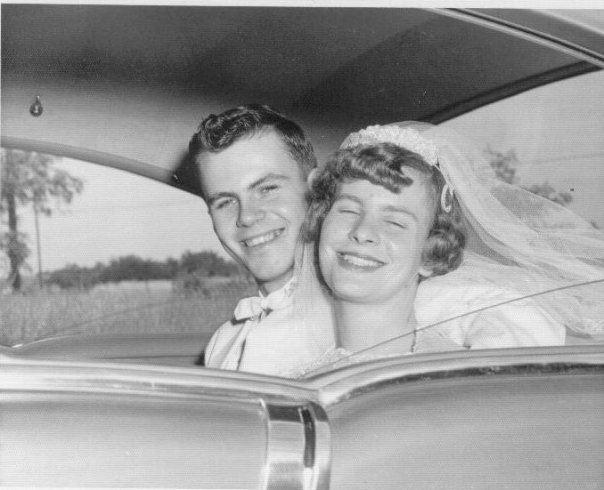
Mom and Dad, 1957


High up on my list of troublesome irks is the occasional need to buy a greeting card. Mother's Day cards are especially problematic. From a distance, most of them look exactly like sympathy cards. Clusters of embossed flowers with loopy, Sorry-For-Your-Loss typography. I always feel a little self-conscious when I reach for one. Opening them seems like stealing a peek at someone's diary. Not a diary that contains unguarded truth or salacious revelations. The other kind. The kind that is emotionally tidy and desperate to be read.

Being a writer of greeting cards has to be a thankless undertaking. You'd have to churn out messages with appealing moods and textures that seem at least partially truthful, while keeping the messages general enough to be somewhat attractive to large numbers of people. The cards you wrote would need to be wistful, but not melancholy, nuanced, but not emotionally complex. And above all, they would need to accommodate the various elephants in the room without even a hint of their presence. An impossible task. One designed to fail. No wonder then that selecting the right card is an exercise in finding the one that fails the least to say what you mean.


When I was a kid my parents socialized a lot in our home, but my brother and I never got to stay up late and hang out with the grownups. We'd be tucked in bed at the appointed hour no matter what. I used to love drifting off to sleep to the sounds of adults laughing and telling stories down the hall.  The stories probably weren't meant for young ears, but I wasn't much interested in their content anyway. It was enough to know the people in charge of my world were happy, and to hear them cut loose with their friends was reassuring. My mother's voice was musical and floated above the others in a pleasing way. To this day I equate the sound of her laughter with a sense of well-being, but to my knowledge there is no card that says Dear Mom, Thanks For Laughing.

One afternoon when I was about ten my cousin and I made a fort out of a refrigerator box. We cut tiny holes for windows and decorated the inside walls with magic markers. Our mural quickly degenerated into scatological hieroglyphics. My cousin spelled out every dirty word we could think of, while I drew anatomically incorrect naked ladies. We giggled ourselves silly. Later, my aunt discovered our debauchery and called my mother to accuse me of being a bad influence. I listened from the next room as I heard my mother say, "My son doesn't even know those words." Up until this moment my mom had convinced herself that she was successfully raising the only child in history that not only did not use cuss words, he didn't even know them. Never mind I could conjugate them backwards and forwards. My mother has always given me the benefit of the doubt, whether I deserved it or not. I'd be thrilled to find a card thanking her for that.

I may have been off the hook for the swear words, but not so the drawings. No one even had to ask who did them. I got grounded, but not long after that my mom got me private art lessons. Partly it was to keep me out of trouble, but also she had been paying attention to my constant art making and thought it might be something worth formally encouraging. When I look back at those drawings they seem completely unremarkable, with the possible exception of my dinosaurs. They were tight. Regardless of what my mom's motivation was, knowingly or not, she set me on the path I'm still on today. But try as I may, I can't find a card that thanks her for taking my dinosaur drawings seriously.

At a certain point I stopped letting my mother kiss me in public. After that I began dodging her good-night kisses. The moisture on her lips would make a little cold spot on my cheek that I'd instantly wipe off. That was probably hurtful to her, but I wouldn't have known. She persisted for a while, trying to win me back from my own impending adolescence, but I was pulling away, growing up - and apart. There were times when I would have gone back and reclaimed a few of those unwanted kisses, but the road to adulthood allows no u-turns. If I chose to be sentimental about it, I'd look for a card that let my mom know her affection wasn't lost on me. Not even in those surly teen years.


 Mom, actual size.

These days I only see my parents two or three times a year. With 2000 miles between us, that's the best we can manage. My mom always wears her orthopedic hiking shoes when she comes out here to Colorado. I fix her and dad up with some trekking poles, and they oblige me as I take them on the mildest trails I can find. We've been hiking together for years. It's what we do. On a recent trip I drove them up a remote jeep trail to have a picnic on a mountain pass high above Crested Butte, Colorado. It was a blustery summer day and the sun beat down on us through the thin atmosphere at 11,000' elevation. We spread our picnic on the hood of the car and washed down turkey sandwiches with Gatorade. Far below us the valley sloped into a glacial bowl filled with summer's fading wildflowers. The first hint of storm clouds were lazily assembling on the horizon. Above us towered Cinnamon Mountain. I knew my folks would never have chosen that place for a picnic, and that my mother was way outside her comfort zone, what with the 4-wheeling, lack of guard rails, and no restrooms. They indulged me, because as mid-westerners, my family is easily smitten with the severe beauty of Colorado, but also because they are learning to trust me to deliver them safely to and fro in the wilderness – which is something.  If I could find a card that said Dear Mom, Thanks For 4-Wheeling With Me, I'd feel like I was getting somewhere.

It's foolish to think something from a card rack could tell my stories for me, or could be grateful in ways that really mattered. No card does that. Flowers don't do it either, though they are an excellent place to start. There are many other ways to be thankful, and I'm just beginning to explore them.

Happy Mother's Day.

For Jeanine Howell


Thursday, May 2, 2013

Lifting the Lid


 Double Rainbow Plans Acrylic and ink on canvas, 46" x 46", 2013

This is a different sort of blog post for me. I've never really been interested in talking about "process" where it concerns my own artwork, mostly because I'm just a painter, and there's no real mystery to what I do. I'm not interacting with mold cultures or programming micro-controllers in the name of art. There's nothing "performative" or interactive about what I do. I sit in front of an easel and slowly render things.

But like most folks, I'm fascinated with the details of other artist's creative practices. There are some artists I'd love to hang out with and watch while they work. It would probably be pretty boring, not to mention totally creepy and distracting for the artist, but I would jump at the chance to see how they get from A to B. In the big picture, an artist's sources of inspiration, his or her work-flow habits, whether or not they're a drinker, and who they sleep with aren't supposed to matter. Art is supposed to be able to "stand on its own" without leaning on a bunch of stories. But I can't help suspect that art never, ever does stand on its own. Not entirely. Social context and the artist's personal history always inform the work. It's one thing to know Mark Rothko intended his paintings to be "spiritual," it's another to know he was a depressed suicidal alcoholic who sought transcendence through his creative practice. Each painting he completed was a milestone on a desperate journey of self-redemption. We might look back now and decide he was tragic, but at the height of his fame, Rothko painted like his life depended on it - like each painting would keep him in the world a little longer.

These sorts of stories aren't just told to keep kids awake in art survey classes. They help give us access to an artist's psyche, and to place them in a meaningful historic context. It is impossible to know these tales and not be influenced by them. We are, after all, story-telling creatures.

So without further delay, I've decided to lift the lid on my own process. Not because I think there is anything novel about it, but because its ordinariness allows uncomplicated access to the ideas behind the work. 


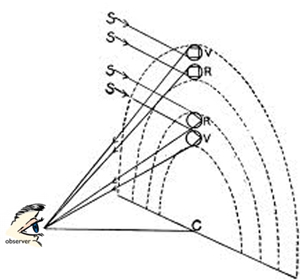
Double Rainbow

Recently, I ran across this double rainbow diagram while perusing images in an old science textbook. I am drawn to these kinds of diagrams because they are attempts to describe complex principles in highly abstract manner meant for ease of instruction. But I also like them for their metaphorical potential when the viewing context is deliberately shifted. I kept returning to this image from time to time to see if I could build a painting around it. Rather than looking like a description of how double rainbows actually work, it began to look like a plan for how to make one, if such a thing were possible. The title Double Rainbow Plans popped into my mind, and almost immediately I wondered what sort of person would be making plans for a double rainbow. A child, probably. Someone beginning to imagine the life ahead. Someone maybe on the doorstep of puberty. Someone with a lot of belief, and more than a little uncertainty.

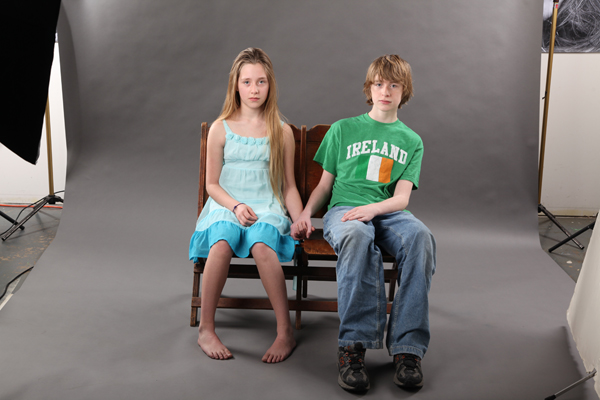
Around this same time I began exploring the idea of doing "double-portraits." These show two views of the same person interacting with him/herself. It was a rather literal way of picturing the self split along the lines of belief/doubt, action/inaction, confidence/fear, and so on. I began looking at my friend's children as possible models. Preferably the parents would be creative types, so there wouldn't need to be a whole lot of cajoling and explaining. When you're asking to photograph someone's children, there's a whole Pandora's box of concerns that could spring open. Fore sure it needed to be done by a professional photographer in a real studio, not in my basement studio; and with a parent present and involved. It was going to cost money.

Pretty quickly I thought of an artist friend I have, Jennifer Jeannelle, and remembered that her kids were not only the right age, and the right sort of "look" I was going for, but having an artist for a mom, they were used to being roped into wacky creative endeavors. I had even seen them doing performance art. I didn't know Jennifer that well, so when I reached out to her it was with great faith that this would make sense to her. I described the double rainbow and the double portrait over the phone without showing her anything. Immediately she began offering great suggestions on wardrobe. She also sold the idea to her kids, Sophie and Eric, so I knew this was going to work. The photographer Anthony Camera was available to do the shoot, and the kids had the following week off for spring break. Perfect.


For the main image, I wanted Sophie to be holding hands with herself. This would involve some Photoshopping, but with Eric's "stand-in" hand to hold, I knew I could get what I wanted. What I hadn't counted on was the sibling's lack of enthusiasm for holding hands with each other. After some coaxing, they settled into their roles, with instructions to keep their hands in exactly the same spot so each of the shots would more or less line up when they switched chairs. The images above show Eric leaning comically away from his sister. Though he wasn't thrilled about holding her hand, he is leaning because we needed him to keep his shadow off of her.

Sophie was directed to have two distinct attitudes in the shot. On the left, she stares straight ahead into the camera, with a look of confidence and the tiniest hint of a smile. This version of herself was to be capable and in-charge. Her other "self" was to lean slightly away, with a look of uncertainty. Both kids took this assignment seriously and gave me exactly what I was looking for, with almost no effort.


After staring at these shots for a couple of days, I decided I liked the effect of the gray sweep we shot the kids against. I had intended to replace it with something else, but the gray began to grow on me.  It just needed some sort of graphic element in the background to activate the space.  I also decided that I didn't like the theater seats in the shot and began looking on Google for something more dramatic. I found a French settee that was shot at a workable angle and had an interesting look. By changing the color from burnt orange to lime green it achieved a pleasant ridiculousness that contrasted nicely with the seriousness of French furniture. The scroll fragments in the background were "stock" illustrations left over from a graphic design job that I licensed them for, but never used.   They went well with the settee, and helped frame the central figures in a way I liked.


At this point I should say that most artists pursue a certain "look" that strikes the right balance between what is expected of them, and what allows for a satisfying deviation from that same expectation. Call it a "style," or if that's too crass, think of it as artistic parameters. Either way, an artist often does a given thing simply because it is the kind of thing they've decided they do. This is part of what gives a body of work coherence. I chose the graphic scrolls in the background because I've been using flat graphics like that for quite some time, and because lately I've shifted toward combining imagery that is contradictory in terms of historical period, allowing me no fixed reference point in time.

After a week of planning, shooting and Photoshopping, it was finally time to make a painting. Along the way I'd decided that this painting needed real presence. I wanted to make it life-size, but it would have been about 6' square. I settled on 46" square, which corresponds to the largest size I can fit in my car.


I've always been up-front about my use of a video projector to rough-in the outlines of my imagery on a blank canvas. I want the proportions to be right, especially with the human figure, and I simply don't have the time, skill, or interest to render everything freehand. I adore the people who can do that, but I'm not one of them. That said, I only trace the outside shape of things. There's simply no point in getting too granular with the tracing lines, because as soon as you begin applying paint you cover them up. One way or another, a painter has to know how to render something using paint. Hence, all the photos taped to my canvas for reference.

Usually, when I get near the completion of a painting I find need to put it away for a few days and go do something else, because by then it has completely taken over my brain and I can't even see it anymore. The hope is that when I return to it again I might actually be able to apprehend it with some degree of clarity. It's usually then when some detail pops out at me and I realized I've gotten a shadow wrong or made a leg too big. After a few rounds like this the work settles into its final form. If all goes well the work may begin to make me smile. Sometimes I really dig it and rush it onto Facebook. Days later I may decide it's not done.

Sometimes I can labor over a painting for weeks without knowing whether it's any good. When it isn't, I have no trouble marching it out to the garage. I've got literally dozens of canvases languishing out there, waiting to be reborn as entirely different paintings. But when it is good, and you move it out to your gallery, it's surprising how big a hole it can leave in your psyche. I'm usually lost for a few days when a painting I love leaves the studio. It stands to reason, given the dozens (sometimes hundreds) of hours I've spent conjuring the thing into being. I miss the people in my paintings. Sometimes I just miss the presence of the thing. Still it takes me by surprise when it's gone, and the only workable remedy is to get started on another one.

Sunday, April 21, 2013

Amateur philosophising on the occasion of my 55th trip around the sun


I've never been that good at looking into the future. The next couple of weeks are somewhat clear to me, but after that it's completely fuzzy. I'm not talking about goals. We can all pack some imaginative details around our goals so that they become palpable, allowing us to daydream about this or that vacation or career change. But that's not seeing the future. Sometimes, when I look at my reflection and find an extra set of lines around my eyes, or see the way the skin under my chin is starting to droop, I think I can see it, but that's not the future either. That's the present. Still the mirror seems like a good place to start. Where else could you expect to find it?

Today is my birthday. This is my fifty-fifth year of being a distinct, conscious, living and breathing person. A fact that is somehow still unimaginable, no matter how I try. I don't know what it means to be 55, but it seems like it ought to mean something. So far, all of the big emblematic birthdays: 30, 40, 50, have all turned out to be false alarms. I've dreaded each of them in turn, because like all of us, I was taught to; supposing each of those ages were milestones on a march into inevitable irrelevance. But like Y2K, they are just days you look back on and feel silly for fussing over, if anything. 

I may be wandering into pure B.S. here, but for the possible benefit of the one or two young people still indulging me, I will offer the only thing I have in the way of insight about aging. It's nothing close to wisdom, just a sort of spoiler alert. It is this: The person you are right now is the same person who will wake up in a 55 year old body someday (hopefully), and you will not be prepared for it, despite your best efforts. Sure, you'll adjust to your bad knees, or the extra 15 pounds, or the increased frequency of getting up to pee at night. And by sheer discipline, you may even decide that you "accept" the effects of aging. Good for you. Nonetheless, one day you will wake up and realize you are finally middle-aged, and this realization will feel sudden, even if you've seen it coming. It may also leave you feeling insulted, because you have never stopped thinking of yourself as being vital, and in-the-moment, and because the core self is entirely unallied with any age or point in time.

When I was three years old my mom caught me melting Crayola crayons onto a register grate on our kitchen floor. It turned out that was a bad thing, but in the moments before I was made aware of that, I experienced the pure joy of exploration. I can still feel the amazement of watching the crayons slowly sagging across the grate then dripping down into the blackness. One by one I melted them onto the register until they were gone, and the smell of wax alerted my mom to the fact that I'd been left alone too long. In fundamental ways, I'm still melting crayons on a register.

Each of us crafts a sense of self from the sum of all our experiences. I am still that curious toddler and also the insecure 12-year old who can't yet talk to a girl AND also the know-it-all 25-year old who can't stop talking, plus whoever else I've been since then. We don't progress through life stages as much as we accumulate them, and each stage in turn informs our sense of self. But the thing that is fundamentally "you" - your core self - transcends age and experience. It sits at the root level of your personality and simply observes, like an unblinking eye. Everything we decide to do, consciously or unconsciously, is in reaction to those core observations. Our habits and passions, our coping strategies, creative proclivities, even our humor proceeds from that inner observer, the true self.

The first time I realized there was a more fundamental sort of self that sat back further in the depths of my own psyche than the conscious mind, was when I was recovering from amnesia several years ago. I had been hit by a speeding drunk driver while riding my bicycle in Chicago. I was briefly hospitalized with a concussion and amnesia. Hospital staff would have let me go home sooner, but they needed to release me into someone's custody who could keep an eye on me for a couple of days. The trouble was, I couldn't remember the names or phone numbers of any of my friends or family, and because I didn't yet have a mobile phone, none of that was at my fingertips. Eventually I was able to think of a friend to come claim me. When I was given the release form to check out of the hospital, I was terrified to realize I had no idea what my signature should look like. Memory recovery was sporadic over the next couple of weeks. One day I panicked to discover I was riding a CTA bus with no idea where I was going or even what street I was on. I jumped off at the next stop and stood there staring at the street sign trying to make it mean something. Slowly the world came into focus and I remembered where I had been headed, and why. I wrote it down on a scrap of paper: "going to work," then waited for the next bus. It was a depressing time. Each blank spot came as a terrifying chasm of loss, no matter how trivial the missing memory would otherwise have been. The effect was brief but overwhelming. Each time it happened I was aware that it was happening, which meant some core aspect of my self was doing critical assessment and seeking to re-integrate, even if I couldn't have told you my name. That's the core self I'm talking about. The Me that's in charge of being Me. And its more than a little bemused by this whole aging business. I don't expect that will change any time soon, but since I'm in good health overall, then there's no rush to accept it. Not yet at least. It's also comforting to know about that unblinking eye at the center of me, who could care less about age, and whose job it is to simply watch, and discover, and to be amazed.

Friday, March 1, 2013

What if we don't make it?


That painting is a good one. You are sure of it. So you post it on Facebook and immediately begin refreshing your browser every thirty seconds hoping for the Like's to start rolling in. Ten minutes go by. Only two Likes and no comments. Damn. You check the time and realize all your friends are probably still at lunch. Bad Facebook timing. You should have waited til 2 o'clock, when everyone is back in front of their computers, but they are drifting and distractible, no longer completely engaged by the demands of their afternoon.

Half an hour later your computer chimes and you dash out of the bathroom with your belt still undone. You've got seven Likes and three comments. Whew. You may not yet be Earning Big Money, but now it seems at least possible that you are not a failure.

The creative temperament has endless triggers for self-doubt and a constellation of worries: What if my prices are wrong and nothing sells? What if nobody goes to that site to vote for my song because it's two clicks away? What if I never get that book contract and end up self-publishing, and only sell a handful of copies to my friends and the co-workers who feel obliged? Why the hell am I doing this?

It's a cruel fact that in an era when the output of blue-chip artists like Damien Hirst and Jeff Koons is traded by the global One Percent as an esoteric futures commodity, that so little money actually changes hands down here at the "emerging" artist level. My own anxiety about never making a decent living from my artwork forces me to rely on sleep aids more nights than I'd care to admit. And yet by some standards I'm making it. I've got a couple of buddies who claim I'm living the dream. Why? Because I quit my career and am selling art for nearly unaffordable prices at a grown-up gallery. And because I have my wife's blessing. But if they knew how few paintings actually sell, or noticed that I've been wearing the same pants to every art opening for six years (thanks to the style longevity of Brooklyn Industries), I would drop right off their list of enviable persons.

Like most anyone reading this, I'm a drop in the bucket now referred to as the creative class. A demographic ghetto of dreamers slogging it out the best we can, pouring other people's lattes, building websites, seeking a tolerable work-life balance that keeps our little creative flames kindled just long enough to draw one more picture or write one more song. We make art because we don't know how to stop. Or because our critical reasoning just isn't that good. Or just possibly, because it saves our lives.

My friend Dylan Scholinski runs an art workshop called The Haven Youth Project that seeks to prevent suicide through creativity and self expression. Many of the kids that go through his program are hanging onto this life by a thread. For them, the transformative power of creative expression is essential to their survival. I try to think of this when I get bogged down by the cynicism of the art world, or when a client takes too long to pay.

I can't say art ever saved my life, but I doubt I could live without it. It's been a refuge since I could hold a crayon. It's also been the only thing anybody ever wanted to pay me for. I sold my first drawings in fourth grade. Some kid noticed I could draw, and he paid me his lunch money every now and then if I'd make pictures for him. He would stand over my shoulder and say, "Put a horse over there. And a barn. Can you do a tractor? Good. That's enough. Now don't sign it!" Turns out he was taking the drawings home to his parents, claiming he'd done them. Before long, word came down from on high that these commissions were to cease. I didn't ask questions. But by then the word was out. Kids knew I could draw. Toward the end of that year I was forced by a bully to do pornographic drawings of Peanuts characters. This bully had already beat me up once, so when he said "Draw a picture of Linus and Lucy doing it," I did. But at age nine I was fuzzy on the mechanics. It was hard enough to draw cartoon characters correctly with their clothes on, but to imagine them naked, with adult sexual organs and in positions I wasn't clear about, was a mind boggling creative challenge. Perhaps the hardest of my life. The bully was there to help with the details. The only thing I thought to say was, "Shouldn't it be Charlie Brown instead of Linus?"

You'd think this assignment would have been humiliating. It wasn't. On the scale of childhood woes, it was way down on the list compared to getting beat up. I took it in stride, and delivered the work. I should have known from those early experiences that I'd do well in advertising, but it didn't become clear for decades.

By the time most of us have decided to make a go of a career in the arts, our heads are filled with ridiculous tripe about what making it means. The metrics for it's measurement, the bohemian fantasies we indulge, the value we place on this or that achievement are all contrivances that will turn on us when the work stops selling. When the world says "meh" to your latest show, inevitably some form of the question "What if I can't make it?" will cast its shadow across the work you thought you liked.

At some point you may become aware, or you may decide that this is the wrong question entirely. At the risk of sounding moralistic, a more useful question is something like "How can I better serve the talent I have?" It may seem old fashioned to think of your creativity being saddled with any sort of obligation. Who would you be obliged to?  In a recent interview, 86 year old singer Tony Bennett claimed the secret to his career longevity was commitment to honoring his talent. Years earlier when he had "gotten into the drugs," Bennett was warned by Lenny Bruce's manager that he was headed down the same path as Lenny, because he was "sinning against his talent." Tony got clean and stayed that way for five decades. In this frame of thinking, the artist's indebtedness is fundamentally to his or her own talent, rather than that talent being something the artist exploits.

The idea that artistic giftedness bears witness to creative forces beyond ordinary human enterprise is persistent across time and culture. Rumi was onto it, so was William Blake, and so is that kid next door flailing away on his guitar in his parent's basement. If creativity is something that can be tapped into or channeled, then it demands a certain respect, if not reverence, and it follows that those of us who have access to it should approach it with discipline if we wish to have it make a regular appearance in our studios. I don't mean for this to sound romantic or mystical. At it's most stripped down, this obligation is about being in service to your own curiosity, and to pursuing it with rigor.

When I was a kid, a friend of mine and I wandered the banks of a river in Kentucky one afternoon. For whatever foolhardy reason, at some point we decided to weave little rafts from dried sticks and leaves, which we waded out into the river with, then lit on fire. We held them at arms length until the flames were well established, then launched the blazing crafts into the swift stream and watched them steam and smoke their way over the rocks and riffles until they drifted out of sight and were presumably destroyed by the river, since the woods around us never erupted in flames. We stood there in the river for a long time. Later we didn't talk about it. It would be years until I encountered the word ineffable, and when I did things started to fall into place.

At the end of the day we all have to make our best guess at what artistic success is going to mean. Attempts at values-clarification and living intentionally, or honing your own personal "brand" may get you part way there. Facebook Likes aren't meaningless indicators either. But success is a moving target, and we'd best be comfortable with the directions changing when we are halfway there. One way or another, I'll always throw my lot in with curiosity and the pursuit of the astonishing. It may be a little old fashioned to be guided by such transcendental values, but in some way I seek to invoke them in everything I create. My best hope is that each painting I make will be a little flaming raft disappearing around a bend in someone's river. It's a goal anyway. I may not ever Earn Big Money, but I'm all in with this journey.

Saturday, December 22, 2012

Bad Human


I knew it was going to be OK to climb Chief Mountain to watch the sunset on the winter solstice. Coming down at night would be a cinch under a cloudless moonlit sky. The packed snowshoe tracks would be easy to follow even without headlamps. What never entered my mind was the trouble my dog was going to have with ice collecting in his paws. People always laugh when they see a dog in boots, but in certain situations they are indispensable, like climbing snowy mountains. Unfortunately, we left the Fido Footware at home, and since our guy did alright on the way up, we figured there was no cause for concern.

On our descent the temperature dropped just enough that ice balls were forming in the thick fur between my dog's toes, which made it painful for him to walk. We'd stop every few dozen yards or so to help him de-ice, but with a couple of miles to go this method was becoming untenable. After a while it occurred to me that I should try to carry him. I gave Kae my backpack, and she helped lift our 60 pound pooch onto my shoulders. I carried him "fireman" style, which left him free to knee me in the head once or twice, but he rapidly figured out what was going on and settled in for the tippy ride. At first I was pleased with how much ground were able to cover quickly. Gravity was on our side. Soon, however, we came to a dense section of woods with low hanging branches. After misjudging their height and banging my buddy's snout a couple of times, he lost confidence in me and began to squirm. We collapsed in a soft patch of snow as I protected my face from his flailing claws.

We resumed our rhythm of paw cleanings at 20 yard intervals for the remainder of our ordeal. Once or twice the moonlight through the trees caught my attention, but only later was I able to recall how beautiful that had been. Somehow we made it back to the trailhead, and I can say I've never been so happy to see our car. The moral of this story is self-evident, so no lectures, thank you please. Suffice to say the dog boots are in the car now, ready for our next adventure.

At home in the yard my dog leapt against me and almost knocked me down. He loves punking me like that when I least expect it. Leaping is a trait most people like to train out of their dogs, but because it has something to do with expressing delight, I'm lenient with it. And last night it's how I knew I'd been forgiven.

Thursday, December 13, 2012

The Dream Argument

José Argüelles' Rainbow Bridge
I have no idea where my wife wants her ashes scattered.

I'd wake her up to ask, but even in my insomnia-addled brain I recognize this isn't a good idea. So I lay there and mull it over quietly. Soon it occurs to me I don't know what I'd do if my dog bit some kid and the Aurora police came to take him away. It doesn't matter that I don't live in Aurora. Somehow those dog-snuffing cops would show up on my doorstep anyway. I'm giving this some serious thought when I realize I have no plan whatsoever for when the planet Nibiru swings around from behind the sun and slams into planet earth, ending life as we know it, only a few days from now.

If you suffer from both insomnia and any sort of anxiety disorder, you will know that the place they intersect is not a pretty one. Tiny seeds of fear, left unattended by the demands of the waking world bloom at night deep in your amygdala. They take on texture and substance in vivid dreams, alerting all areas of your brain to the presence of a real problem. Soon you are awake enough to give these cascading worries your full attention, and no matter how still you lie, or what sort of mental exercises you practice, you will not be going back to sleep. Never mind that all of these troubles are laughable by the light of day. There are just enough threads of reasonability tethering your phantoms to reality that they will make you their servant for the remainder of this otherwise quiet night.


In full disclosure, it probably was a bad idea to watch a documentary on 2012 Doomsday Cults directly before going to bed last night. I had not known there are so many people hiding in caves and bunkers all over the earth right now getting ready for something big to happen on December 21. Some of these people have quit their jobs, withdrawn their money from banks, and bought cheese and beans and ammunition. But not all of them are the kind you see wearing camo at the Walmart when it isn't hunting season. New Age author José Argüelles, who brought us the Harmonic Convergence, is organizing a simultaneous worldwide meditation event that will use the combined power of all the like-minded meditators to literally deflect apocalyptic solar flares away from the earth and channel them into a rainbow bridge that arcs from pole to pole. And if that's not your style, there's even an Arizona developer building fully stocked underground condos in a converted MX missile silo at 900K a pop. If things are about to get really bad, those folks are set to ride it out in style.

Cultural variations aside, these Doomsday clubs have a lot in common. Their thought leaders are all relentless self-publishers, whose source material typically includes aerial photos of crop circles, secondhand interpretations of Mayan tablets, and wild reinterpretations of ancient Sumerian astrology. What they lack in scientific rigor, they make up for with passion and imagination. These groups also share a reliance on social media to organize, raise funds, sell survival stuff to each other, and generally keep the fear fires burning hot. But the shared trait that surprised me most is their utterly pragmatic approach to the end of the world. This isn't your grandfather's Armageddon, where Good and Evil have it out one last time in a cosmic Battle Royale. This is going to be an entirely secular cataclysm, where only the prepared survive. Sure, some of these folks will quote the Bible or some other sacred text, but they aren't concerned with righteousness, they simply want to outwit the prophesies.

It's easy to assume 2012 survivalism appeals primarily to the socially marginalized. A sense of estrangement from the natural order would add even more to their numbers. But that doesn't explain the mass appeal of this latest end-times scenario. The search term "Doomsday 2012" returns over 72 million pages on Google. I can't help but wonder if the desire for disaster isn't a projection of a culture that yearns for global catharsis, even if it came at the expense of millions of dead people. Visit any doomsday website, and once you get past all the predictions of catastrophe what you find are twisted messages of hope. Many use the word "rebirth," fully acknowledging the word implies lots of blood and pain.

I find the obsession with 12/21 to be a culturally constructed "straw man" that facilitates us fantasizing about surviving an instantaneous cataclysm, while distracting us from the mundane and depressing effects of things like global warming, which is its own sort of slow-motion apocalypse, but much more hopeless in its way. That said, there is something to be admired in the folks who get hands-on when responding to these potential world-ending scenarios. Agreeing on which are the real threats is the hard part. Some of us stockpile food and weapons and head underground. Others drive hybrids and put solar panels on their roofs. Either way, it's doing something that makes the Bad Situations seem a bit more manageable.


There is an ancient philosophical conundrum concerning the illusory nature of reality called the Dream Argument. Plato and Aristotle both took it on. The crux of it is that since we do not know we are dreaming while we are in a dream, and yet our dreams are filled with the same sensations we experience when we are awake, how then can we trust those senses to tell us when we're awake? Or said even simpler, how do we know we are ever awake? French mathematician-philosopher Descartes said that while our senses are not particularly trustworthy, reality itself is separate from us and to some degree knowable. Later philosophers focused on the social construction of reality and the practical necessity for a consensus on what is real. So it seems that to this day the jury is still out on reality. What is certain is that our anxieties invade our dreams, and our dreams in turn create images that haunt our waking world. What separates dream from reality is less a door than a passage through fog.

If the Doomsayers turn out to be right, then it won't be canned provisions and weapons I'll regret not stocking up on. It will be sleeping pills. At the end of the day, I have enough trouble outwitting my own petty demons, and staying on a predictable sleep cycle.  I can't trouble myself with phantom planets. Besides, I'd rather rest in peace with the skeptics than spend the rest of my post-apocalyptic days roasting rabbits I snared myself on the bonfires of Ikea furniture while fending off marauding bands of feral suburban teens. You can have that world. If I can trust anything at all, it is that the NASA scientists are dead-on, and they all say not to sweat it. So I'm not sweating it. There may come a day when they let us know we can start to worry about this or that comet or solar flare, until then my money is on December 21st being an entirely ordinary winter solstice. The chilly, partly cloudy kind, with a killer sunset. So to speak.