Showing posts with label creative process. Show all posts

Saturday, November 23, 2019

Astronaut


Astronaut - Colored pencil, acrylic and gel transfer on wood panel, 45″ x 55″

Sometimes you make a thing - a painting, a song, or whatnot - and it goes nowhere. You may think it’s one of your better pieces, but it gathers no momentum. It doesn’t get shared or reposted. It doesn’t sell. This may leave you flummoxed because you’re pretty sure it’s actually quite good. But you have no way of knowing for certain, since you’re the one who made it.

In a recent review of Layers of Existence, Ray Rinaldi writes about a painting I did back in 2013 called Astronaut that was a last minute addition to the current show, chosen by the gallery. What’s funny is that Astronaut was one of those paintings that originally went nowhere. I figured the subject matter probably came off as a little dark, or confusing or just plain odd, and that this is not the kind of art most people want over their couch. I suspected this at the time I was painting it, which is partly why I painted a gaudy couch in the painting, as if to preemptively acknowledging the act of sabotage that a “difficult” painting might prove to be. But I also felt like there was something really human and honest about the painting, like I’d stumbled upon a sort of existential pathos that I would never have dared to approach directly as a subject. At the time, I had mostly been concerned with juxtaposing various cultural references. I was new to figurative realism, so I was intentionally taking it easy with emotional content, not wanting to get in over my head and end up doing something cliché or sentimental. But as is often the case, the restrained impulse expresses itself one way or another, and somewhere in its making the painting acquired a haunting aspect that felt pretty authentic. So when Astronaut went into storage after the show six years ago, I kind of felt like I must have missed the mark. Maybe the ideas I was exploring in it weren't actually that relatable. This is an ordinary disappointment that all creative people have to deal with when they least expect it, but it's part of the game.

I was surprised to learn the gallery added Astronaut to my latest group of paintings, but it made perfect sense, given that the theme of identity is what the exhibit is built around. I was again surprised that Rinaldi mentioned it in writing. He picked up on the Pieta reference, which I was happy about, since I’ve had to explain that one a lot - cultural literacy being what it is these days. He also picked up on the contradictions that are at the core of questions of identity. So for me this was a win. I’ve always thought Astronaut was a positive painting. The central figure is strong and confident and stares straight ahead at the viewer. The version of himself that he holds on his lap has his eyes wide open, lost in some sort of reverie or waking dream, not necessarily dead. That’s what I was thinking anyway. I was also aware that the Pieta reference could prompt an interpretation having to do with the death of ego, or something along those lines. Either way, I knew this image was "loaded," which is another way of saying hard to sell. But there it is. Sometimes a piece of art just wants to be made. Astronaut may have spent a good deal of its life in storage, but right now it’s having a little moment. And I still like it.

Wednesday, July 24, 2013

Holding Pattern - repost


1980.

Right after college I had a job as a security guard on the graveyard shift at The Fayette Shopping Mall in Lexington Kentucky. With my B.A. in art, this was the best I could do at the time. I suspected it was possibly the worst job ever, but didn't have much to compare it to. One night, just before Christmas, I found a bottle of Wild Turkey Kentucky bourbon in my mail cubby in the security office at the mall. A little tag said Merry Xmas, from the management. I made it about halfway through that shift without touching it.

One of my most dreaded obligations as a mall cop was investigating cars that had been left overnight in the parking lot. Usually these cars were parked way off in the darkest stretches of the lot, near the railroad tracks. They often contained people having sex. It was my duty to ask them to move along. If the cars were empty I was supposed to affix a giant day-glo sticker that read PARKING VIOLATION to the driver's side window. I discovered right away that people having drunk sex in a mall parking lot in Kentucky are not super welcoming to a kid with a badge, a flashlight and a can of mace. Certain that they had better weapons than I did, I took to doing this part of my job as the sun was coming up, when most of the cars were gone.

One night after a midnight showing of Rocky Horror at the cineplex, I found a bag of weed on the floor near the theater exit doors. I made a gift of it to the guys who ran the cleaning service, who I knew to be stoners. In return, I enlisted their help with my parking lot woes. They had a large vacuum sweeper truck which was used every night to scrub trash off the lot. This truck had lights all over it and the vacuum motor was insanely loud. The cleaning guys were in the habit of sweeping the lot at a troublingly high speed, probably because they were bored out of their skulls. That's where I got the idea to have them use their truck to gently intimidate anyone they might happen upon in a parked car. They took to this task with relish. It was as if I had just given them a promotion. Needless to say my trouble with parkers went away pretty quickly.

About half of my nightly rounds took place outside the mall. This involved creeping around the dumpsters in the loading bays behind all the stores with my mag light. After being startled out of my wits a couple of times by dumpster divers, I took to finding ways to make enough noise that the mall's nocturnal fringe dwellers would have a chance to scatter, and I could avoid confrontation altogether. Around this same time, inexplicably, a saxophone showed up in the Mall's lost and found. After weeks of eying it and hoping no one would claim it, I decided to borrow the horn. I bought a fresh pack of reeds, certain I could teach myself to play. I really wanted to be in a band, and this was back when everyone was adding horns to their rock bands. So I took to playing the borrowed horn at work, figuring I could use it both as a warning device on my rounds, and to stave off the mind-numbing dullness of being alone and awake in a mall at night.

My supervisor surprised me one night when I was sitting in the information kiosk practicing scales. He never said a thing about the horn, but that was likely because I had some goods on him that he was eager for me never to mention. One night I'd gotten to work a little early and caught him having sex with the manager from the Orange Julius on the black vinyl couch in the security office. He'd swung his one free hand at me as if to bat me away. I left quickly, but took the time to re-lock the door on my way out. I went and sat in my car until exactly midnight. When I re-entered the office to start my shift they were gone. I propped the office door open to air it out. I don't know if it needed airing out because I wasn't breathing through my nose. I wasn't taking chances. The Orange Julius lady never looked me in the eye after that, and I never said a thing to anyone. I enjoyed thinking my chances were pretty good at landing the next open slot on the day shift. That was until I was caught with the horn, and knew I'd been trumped.

The night I found my holiday gift of bourbon the skies opened up with a deluge that was weeks overdue - the kind of rain that stalls cars in underpasses and makes traffic lights blink red. I needed to start my rounds, but stood in the doorway waiting for the downpour to let up, feeling stuck, in more ways than one. I had recently admitted to myself that I was hopelessly trapped in some sort of holding pattern, without enough velocity to escape. Most of my friends from school had found jobs elsewhere or moved back home with their parents, while I stayed behind in the small college town and tried to imagine how to be an artist. I had spent a year at the mall and only had a folder of bad poetry and some rudimentary horn skills to show for my effort. Not to mention a reputation at the mall as an utter freak show. By day, I was attempting to carry on making paintings, exactly like I had just spent four years doing in school, but the handful I managed to complete looked exactly like an amalgam of my former professor's work.  Discouraged, I took to translating rock lyrics into french, a language I'd studied for three years but knew I'd never travel enough to really use. By the time I finished translating all the lyrics for Supertramp's "Breakfast in America" I knew something had to change. I had set my sights somewhat randomly on Chicago, and had pinned all my hopes on moving there to pursue the life-creative. I'd only visited the city twice before, and had no friends there, but was certain I wanted to live there. I knew the city would wake me up, if I could just scrape up enough money to get there. In preparation, I had already started dressing like an artist. I was wearing intentionally ironic suits from thrift stores. I stopped listening to Supertramp and Genesis in favor of Talking Heads and Patti Smith. If I wasn't yet an artist, I was damn sure going to do a good impersonation of one. There's some wisdom in the cliché, "fake it till you make it," and that was as close as I came to having a strategy.

The rain never did let up, and I knew it wasn't going to. Not that night. So I twisted off the cap on the bourbon, took a big gulp, stashed it back in my mail cubby, then headed out on my rounds. After all, I was 22 years old, and in charge of the entire Fayette Mall in Lexington Kentucky. I had a flashlight, a can of mace, it was raining, and I had a saxophone. I knew what to do.

Thursday, May 2, 2013

Lifting the Lid


 Double Rainbow Plans Acrylic and ink on canvas, 46" x 46", 2013

This is a different sort of blog post for me. I've never really been interested in talking about "process" where it concerns my own artwork, mostly because I'm just a painter, and there's no real mystery to what I do. I'm not interacting with mold cultures or programming micro-controllers in the name of art. There's nothing "performative" or interactive about what I do. I sit in front of an easel and slowly render things.

But like most folks, I'm fascinated with the details of other artist's creative practices. There are some artists I'd love to hang out with and watch while they work. It would probably be pretty boring, not to mention totally creepy and distracting for the artist, but I would jump at the chance to see how they get from A to B. In the big picture, an artist's sources of inspiration, his or her work-flow habits, whether or not they're a drinker, and who they sleep with aren't supposed to matter. Art is supposed to be able to "stand on its own" without leaning on a bunch of stories. But I can't help suspect that art never, ever does stand on its own. Not entirely. Social context and the artist's personal history always inform the work. It's one thing to know Mark Rothko intended his paintings to be "spiritual," it's another to know he was a depressed suicidal alcoholic who sought transcendence through his creative practice. Each painting he completed was a milestone on a desperate journey of self-redemption. We might look back now and decide he was tragic, but at the height of his fame, Rothko painted like his life depended on it - like each painting would keep him in the world a little longer.

These sorts of stories aren't just told to keep kids awake in art survey classes. They help give us access to an artist's psyche, and to place them in a meaningful historic context. It is impossible to know these tales and not be influenced by them. We are, after all, story-telling creatures.

So without further delay, I've decided to lift the lid on my own process. Not because I think there is anything novel about it, but because its ordinariness allows uncomplicated access to the ideas behind the work. 
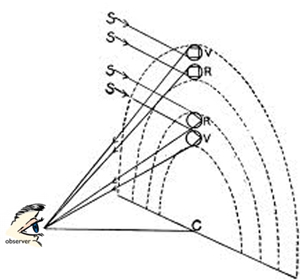

 
Double Rainbow

Recently, I ran across this double rainbow diagram while perusing images in an old science textbook. I am drawn to these kinds of diagrams because they are attempts to describe complex principles in highly abstract manner meant for ease of instruction. But I also like them for their metaphorical potential when the viewing context is deliberately shifted. I kept returning to this image from time to time to see if I could build a painting around it. Rather than looking like a description of how double rainbows actually work, it began to look like a plan for how to make one, if such a thing were possible. The title Double Rainbow Plans popped into my mind, and almost immediately I wondered what sort of person would be making plans for a double rainbow. A child, probably. Someone beginning to imagine the life ahead. Someone maybe on the doorstep of puberty. Someone with a lot of belief, and more than a little uncertainty.

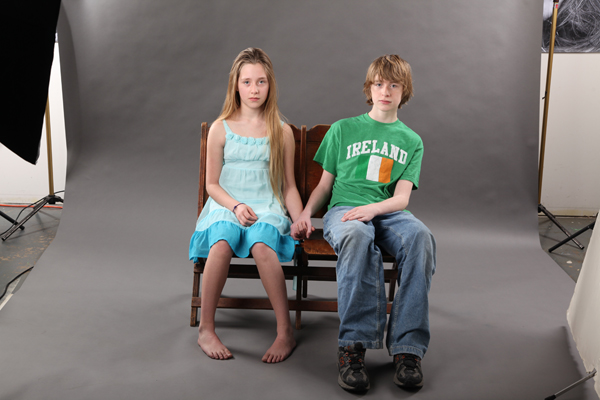
Around this same time I began exploring the idea of doing "double-portraits." These show two views of the same person interacting with him/herself. It was a rather literal way of picturing the self split along the lines of belief/doubt, action/inaction, confidence/fear, and so on. I began looking at my friend's children as possible models. Preferably the parents would be creative types, so there wouldn't need to be a whole lot of cajoling and explaining. When you're asking to photograph someone's children, there's a whole Pandora's box of concerns that could spring open. Fore sure it needed to be done by a professional photographer in a real studio, not in my basement studio; and with a parent present and involved. It was going to cost money.

Pretty quickly I thought of an artist friend I have, Jennifer Jeannelle, and remembered that her kids were not only the right age, and the right sort of "look" I was going for, but having an artist for a mom, they were used to being roped into wacky creative endeavors. I had even seen them doing performance art. I didn't know Jennifer that well, so when I reached out to her it was with great faith that this would make sense to her. I described the double rainbow and the double portrait over the phone without showing her anything. Immediately she began offering great suggestions on wardrobe. She also sold the idea to her kids, Sophie and Eric, so I knew this was going to work. The photographer Anthony Camera was available to do the shoot, and the kids had the following week off for spring break. Perfect.


For the main image, I wanted Sophie to be holding hands with herself. This would involve some Photoshopping, but with Eric's "stand-in" hand to hold, I knew I could get what I wanted. What I hadn't counted on was the sibling's lack of enthusiasm for holding hands with each other. After some coaxing, they settled into their roles, with instructions to keep their hands in exactly the same spot so each of the shots would more or less line up when they switched chairs. The images above show Eric leaning comically away from his sister. Though he wasn't thrilled about holding her hand, he is leaning because we needed him to keep his shadow off of her.

Sophie was directed to have two distinct attitudes in the shot. On the left, she stares straight ahead into the camera, with a look of confidence and the tiniest hint of a smile. This version of herself was to be capable and in-charge. Her other "self" was to lean slightly away, with a look of uncertainty. Both kids took this assignment seriously and gave me exactly what I was looking for, with almost no effort.


After staring at these shots for a couple of days, I decided I liked the effect of the gray sweep we shot the kids against. I had intended to replace it with something else, but the gray began to grow on me.  It just needed some sort of graphic element in the background to activate the space.  I also decided that I didn't like the theater seats in the shot and began looking on Google for something more dramatic. I found a French settee that was shot at a workable angle and had an interesting look. By changing the color from burnt orange to lime green it achieved a pleasant ridiculousness that contrasted nicely with the seriousness of French furniture. The scroll fragments in the background were "stock" illustrations left over from a graphic design job that I licensed them for, but never used.   They went well with the settee, and helped frame the central figures in a way I liked.


At this point I should say that most artists pursue a certain "look" that strikes the right balance between what is expected of them, and what allows for a satisfying deviation from that same expectation. Call it a "style," or if that's too crass, think of it as artistic parameters. Either way, an artist often does a given thing simply because it is the kind of thing they've decided they do. This is part of what gives a body of work coherence. I chose the graphic scrolls in the background because I've been using flat graphics like that for quite some time, and because lately I've shifted toward combining imagery that is contradictory in terms of historical period, allowing me no fixed reference point in time.

After a week of planning, shooting and Photoshopping, it was finally time to make a painting. Along the way I'd decided that this painting needed real presence. I wanted to make it life-size, but it would have been about 6' square. I settled on 46" square, which corresponds to the largest size I can fit in my car.


I've always been up-front about my use of a video projector to rough-in the outlines of my imagery on a blank canvas. I want the proportions to be right, especially with the human figure, and I simply don't have the time, skill, or interest to render everything freehand. I adore the people who can do that, but I'm not one of them. That said, I only trace the outside shape of things. There's simply no point in getting too granular with the tracing lines, because as soon as you begin applying paint you cover them up. One way or another, a painter has to know how to render something using paint. Hence, all the photos taped to my canvas for reference.

Usually, when I get near the completion of a painting I find need to put it away for a few days and go do something else, because by then it has completely taken over my brain and I can't even see it anymore. The hope is that when I return to it again I might actually be able to apprehend it with some degree of clarity. It's usually then when some detail pops out at me and I realized I've gotten a shadow wrong or made a leg too big. After a few rounds like this the work settles into its final form. If all goes well the work may begin to make me smile. Sometimes I really dig it and rush it onto Facebook. Days later I may decide it's not done.

Sometimes I can labor over a painting for weeks without knowing whether it's any good. When it isn't, I have no trouble marching it out to the garage. I've got literally dozens of canvases languishing out there, waiting to be reborn as entirely different paintings. But when it is good, and you move it out to your gallery, it's surprising how big a hole it can leave in your psyche. I'm usually lost for a few days when a painting I love leaves the studio. It stands to reason, given the dozens (sometimes hundreds) of hours I've spent conjuring the thing into being. I miss the people in my paintings. Sometimes I just miss the presence of the thing. Still it takes me by surprise when it's gone, and the only workable remedy is to get started on another one.

Friday, March 1, 2013

What if we don't make it?


That painting is a good one. You are sure of it. So you post it on Facebook and immediately begin refreshing your browser every thirty seconds hoping for the Like's to start rolling in. Ten minutes go by. Only two Likes and no comments. Damn. You check the time and realize all your friends are probably still at lunch. Bad Facebook timing. You should have waited til 2 o'clock, when everyone is back in front of their computers, but they are drifting and distractible, no longer completely engaged by the demands of their afternoon.

Half an hour later your computer chimes and you dash out of the bathroom with your belt still undone. You've got seven Likes and three comments. Whew. You may not yet be Earning Big Money, but now it seems at least possible that you are not a failure.

The creative temperament has endless triggers for self-doubt and a constellation of worries: What if my prices are wrong and nothing sells? What if nobody goes to that site to vote for my song because it's two clicks away? What if I never get that book contract and end up self-publishing, and only sell a handful of copies to my friends and the co-workers who feel obliged? Why the hell am I doing this?

It's a cruel fact that in an era when the output of blue-chip artists like Damien Hirst and Jeff Koons is traded by the global One Percent as an esoteric futures commodity, that so little money actually changes hands down here at the "emerging" artist level. My own anxiety about never making a decent living from my artwork forces me to rely on sleep aids more nights than I'd care to admit. And yet by some standards I'm making it. I've got a couple of buddies who claim I'm living the dream. Why? Because I quit my career and am selling art for nearly unaffordable prices at a grown-up gallery. And because I have my wife's blessing. But if they knew how few paintings actually sell, or noticed that I've been wearing the same pants to every art opening for six years (thanks to the style longevity of Brooklyn Industries), I would drop right off their list of enviable persons.

Like most anyone reading this, I'm a drop in the bucket now referred to as the creative class. A demographic ghetto of dreamers slogging it out the best we can, pouring other people's lattes, building websites, seeking a tolerable work-life balance that keeps our little creative flames kindled just long enough to draw one more picture or write one more song. We make art because we don't know how to stop. Or because our critical reasoning just isn't that good. Or just possibly, because it saves our lives.

My friend Dylan Scholinski runs an art workshop called The Haven Youth Project that seeks to prevent suicide through creativity and self expression. Many of the kids that go through his program are hanging onto this life by a thread. For them, the transformative power of creative expression is essential to their survival. I try to think of this when I get bogged down by the cynicism of the art world, or when a client takes too long to pay.

I can't say art ever saved my life, but I doubt I could live without it. It's been a refuge since I could hold a crayon. It's also been the only thing anybody ever wanted to pay me for. I sold my first drawings in fourth grade. Some kid noticed I could draw, and he paid me his lunch money every now and then if I'd make pictures for him. He would stand over my shoulder and say, "Put a horse over there. And a barn. Can you do a tractor? Good. That's enough. Now don't sign it!" Turns out he was taking the drawings home to his parents, claiming he'd done them. Before long, word came down from on high that these commissions were to cease. I didn't ask questions. But by then the word was out. Kids knew I could draw. Toward the end of that year I was forced by a bully to do pornographic drawings of Peanuts characters. This bully had already beat me up once, so when he said "Draw a picture of Linus and Lucy doing it," I did. But at age nine I was fuzzy on the mechanics. It was hard enough to draw cartoon characters correctly with their clothes on, but to imagine them naked, with adult sexual organs and in positions I wasn't clear about, was a mind boggling creative challenge. Perhaps the hardest of my life. The bully was there to help with the details. The only thing I thought to say was, "Shouldn't it be Charlie Brown instead of Linus?"

You'd think this assignment would have been humiliating. It wasn't. On the scale of childhood woes, it was way down on the list compared to getting beat up. I took it in stride, and delivered the work. I should have known from those early experiences that I'd do well in advertising, but it didn't become clear for decades.

By the time most of us have decided to make a go of a career in the arts, our heads are filled with ridiculous tripe about what making it means. The metrics for it's measurement, the bohemian fantasies we indulge, the value we place on this or that achievement are all contrivances that will turn on us when the work stops selling. When the world says "meh" to your latest show, inevitably some form of the question "What if I can't make it?" will cast its shadow across the work you thought you liked.

At some point you may become aware, or you may decide that this is the wrong question entirely. At the risk of sounding moralistic, a more useful question is something like "How can I better serve the talent I have?" It may seem old fashioned to think of your creativity being saddled with any sort of obligation. Who would you be obliged to?  In a recent interview, 86 year old singer Tony Bennett claimed the secret to his career longevity was commitment to honoring his talent. Years earlier when he had "gotten into the drugs," Bennett was warned by Lenny Bruce's manager that he was headed down the same path as Lenny, because he was "sinning against his talent." Tony got clean and stayed that way for five decades. In this frame of thinking, the artist's indebtedness is fundamentally to his or her own talent, rather than that talent being something the artist exploits.

The idea that artistic giftedness bears witness to creative forces beyond ordinary human enterprise is persistent across time and culture. Rumi was onto it, so was William Blake, and so is that kid next door flailing away on his guitar in his parent's basement. If creativity is something that can be tapped into or channeled, then it demands a certain respect, if not reverence, and it follows that those of us who have access to it should approach it with discipline if we wish to have it make a regular appearance in our studios. I don't mean for this to sound romantic or mystical. At it's most stripped down, this obligation is about being in service to your own curiosity, and to pursuing it with rigor.

When I was a kid, a friend of mine and I wandered the banks of a river in Kentucky one afternoon. For whatever foolhardy reason, at some point we decided to weave little rafts from dried sticks and leaves, which we waded out into the river with, then lit on fire. We held them at arms length until the flames were well established, then launched the blazing crafts into the swift stream and watched them steam and smoke their way over the rocks and riffles until they drifted out of sight and were presumably destroyed by the river, since the woods around us never erupted in flames. We stood there in the river for a long time. Later we didn't talk about it. It would be years until I encountered the word ineffable, and when I did things started to fall into place.

At the end of the day we all have to make our best guess at what artistic success is going to mean. Attempts at values-clarification and living intentionally, or honing your own personal "brand" may get you part way there. Facebook Likes aren't meaningless indicators either. But success is a moving target, and we'd best be comfortable with the directions changing when we are halfway there. One way or another, I'll always throw my lot in with curiosity and the pursuit of the astonishing. It may be a little old fashioned to be guided by such transcendental values, but in some way I seek to invoke them in everything I create. My best hope is that each painting I make will be a little flaming raft disappearing around a bend in someone's river. It's a goal anyway. I may not ever Earn Big Money, but I'm all in with this journey.

Monday, September 24, 2012

Beach Blind


 She was nudged by a manatee. She was a child raking clams in shallow water, somewhere in Florida. It was 1980. The manatee bumped her just slightly, whether the result of curiosity, poor eyesight, or as some sort of message. She turned around to see the huge leathery sea cow gliding off into deeper water.

Until this moment the girl does not know manatees exist.


This memory has become important to her for a variety of reasons. Now, as an artist, she has decided to tackle the telling of it in the form of an experimental performance piece that will put performers inside sculptural constructions, out of which they cannot see, as they "kind of rove slowly around the floor" of the gallery. She says the piece will be about blind faith. The title of the exhibit will be "Half The Floating World."  It will be a group show that she will curate. She invites me to create a piece for it.


I read all this in an email, on my smartphone, while laying on a beach.


It is day nine of our annual family vacation on the eastern shore of Virginia. All week long siblings, children, girlfriends and boyfriends rotate through our rented beach house. Days are spent getting tossed around in the vigorous surf until exhausted, followed by a stumble up the sand for a nap under the umbrella, or to fall asleep with a good book in a beach chair designed to last exactly one week. All of this set against the music of crashing waves and sand-muffled sounds of children playing. In the evenings, we make fantastic meals for each other, drink uncomplicated wine and tell new variations of the same old stories. It's idyllic in an unambitious, middle-class way, and I love it completely. But it makes it hard to remember my life back home, and by day nine I have had enough. Not of the family, but of the opiating effects of the beach. 


I'm thinking about all of this as I struggle to lift my head from a nap on the sand. I am stretched out beneath a big striped umbrella, covered with sunscreen, but I feel the UV making me red anyway. From where I lie, I can see the sun through two colored bands of umbrella fabric. When I close my right eye the sun is a fuzzy pink disc. If I close my left, it is green. I blink back and forth a few times making the sun jump between colors until my mind reconnects with that little grain of anxiety that brings me all the way awake. Time to head back into the water.


Every year I come out here thinking I will use this unallocated free time to start some new project. Maybe rethink my website design or do some sketches for new paintings. Once or twice I've actually tried to work on freelance design jobs out here. But every year I come back empty handed. Rested, but dull in the head. Rudderless. Vacated.


My friend's email is a welcome intrusion as I begin to plot my re-entry into real life. I know the show she is planning is likely to be good. She's a visionary whose career is on a bit of a roll. It can't hurt to be a part of this, whatever it turns out to be. I re-read her message to make sure I've got the title right. "Half The Floating World." I have no idea what this means, or how it connects with blind faith, but I love something about it. I'm certain that when I talk to her she will fill in the blanks, but in the meantime I know the puzzlement and wonder those gaps create are exactly the places creativity thrives. But blind faith? I have no idea what this is. I'm pretty sure everyone thinks their faith is informed, regardless if it is faith in a god, or in a partner, or a country, or even that your car is going to be there where you left it. But blind faith sounds risky. Unhinged. Foolish. I'm trying to think of a good example. Even in that bible story where Jesus calls Peter to step out of his boat and come walk on the water with him. Was that blind faith? Probably not, since Jesus was already out on the water, suggesting some new faith-enabled feasibility was at work. Either way I'm guessing Peter's fingers were crossed as his toes hit the water.


Finally on my feet, I decide to take a walk to give this creative challenge some time on the front burner, but my brain is over-rested and fogged-in by salt air and mid-Atlantic heat, and the ideas just aren't there. What if I don't come up with anything? This is what the fearful part of my brain always asks. Its tiny voice is there to remind me I might fail. I don't resent it, or seek to suppress it, because it's looking out for my best interests. Besides, there is another stronger part of me that knows I will find a creative solution. The same way I don't have to look at my feet when I walk. It just happens, thankfully.


I'm headed down the beach without my glasses. Normally I'd be wearing them for any viewing beyond arms length, but the blowing sand is hard on the plastic lenses, so I leave them in my beach bag. Until now I've forgotten how truly bad my distance vision is. All shapes have their edges rounded off, like beach glass, and radiate faint halos. I decide it's okay to keep walking, carefully, since I can still make out where all the people and umbrellas are. I look back at my own and memorize its cluster of colors. I tell myself I like the challenge of negotiating this impressionistic scene, except the lack of detail is beginning to make me paranoid, and with good reason. I freeze as I discover I've wandered into a congregation of kite fliers. I should have remembered they were here. They are mostly children, from what I can tell, and the blurry colors just overhead are their kites. A stiff offshore breeze keeps the kites flying at a low angle, the highest ones only thirty feet up. I know, without seeing it, that the air just above this expanse of sand is bisected by invisible strings. Strings that would be hard to make out even with 20/20 vision. It's hard to tell how many of the people around me are flying kites. Ten, twelve? Better to count the kites. At first I find eight but then realize two are multi-part contraptions, so six it is. Good. Now, how to work out a passage away from them that doesn't involve crashing some kid's kite or slicing myself on the taught strings? The next few minutes are spent cautiously zig zagging between kite fliers, and willing—without effect—for the strings to come into view.


At last I make it down to the water's edge, uninjured and unembarrassed. The way back up the beach toward my family is reasonably apparent, so I take a minute to jump in the Atlantic and cool off. I have completely forgotten about trying to have a creative idea regarding blind faith, or anything else. At the moment, I am at least part of the floating world, but which half, I cannot say.


Shadows drift below me in the cloudy surf, but even without corrective eyewear I know they are shadows of my own creation and not to be feared. Further out, just past the surfers, dolphins ply the whitecaps in the afternoon sun. Beyond them, the occasional marlin is unlucky in it's choice of prey and lands thrashing on the deck of a boat. And miles further out, Right whales migrate south along the rim of the underwater Accomac Canyon. These waters are rich with pelagic mysteries, some bumping us, moving us along, some capable of tearing us limb from limb. But there are no manatees here. We are too far north.

Back at our beach enclave I locate my glasses case and peek inside at the unsanded lenses. Among the many things I am thankful for, these glasses are at this moment right on top of the list. But I do not put them on. I snap the case closed and stow it back in my bag. I'm okay without them for now. I stretch back out onto my towel and close my eyes under the striped umbrella.

Tuesday, April 10, 2012

We're all going to die, so please buy my art.


Today I went to the Madden Museum in Greenwood Village, to judge an art show by high school students. The Madden is what they sometimes refer to as a "vanity" museum; in this case, an enormous glass and steel structure built to house the legacy of a rich guy. The building is in Denver's sprawling suburban Tech Center, where gleaming corporate high rises thrust up from the prairie next to an eight lane highway. The name of the building is the Pallazzo Verdi, and the road that leads to it is called Fiddlers Green. Mind you, this is in suburban Denver. All of this would be easy to dismiss as irrelevant cultural grandstanding by yet another wealthy cowboy developer, were it not true that many important museums are vanity projects (think Marshall Field, JP Getty, Guggenheim), and that the Madden Museum houses some truly noteworthy pieces.

Twelve schools participated in the Continental League Art Exhibit, which is designed to showcase and reward excellence in the arts. Settling into the show, I found the usual scratchboard drawings of cats, and melodramatic self-portraits, but also some truly unexpected departures into combined media, and honest stabs at self discovery. A couple of the pieces felt vital, as if they not only mattered to their creators, but that they had the power to matter to passing strangers. It occurred to me that this is the best any artist could hope for.

My favorite moment came when I rounded a corner and saw an especially nice Robert Rauschenberg piece from the Madden's permanent collection that had been pushed into an unlit storage area to make room for the high school art show. I'm not sure if this was some sort of afterthought, or if I had arrived before they were finished moving things around, but if it were my museum, I'd make sure my blue chip art was either on a wall, or safely out of sight. Nonetheless, something about seeing the Rauschenberg there was both sad and wonderful, like the sight of dethroned royalty. The fact that it still projected a powerful presence from its dark corner made me like it all the more. The most surprising thing though, was seeing that the museum was willing to completely redefine itself to showcase the art of young people, many of whom are just beginning to suspect that art might be something of consequence to them.

Whether my artwork, or that of any of my artist friends, or the kids in this show will end up in someone's legacy, or in a thrift store, is anyone's guess. A friend of mine was recently tipped off that a painting by a well-known local artist was available at a certain thrift store for only a few bucks. The painting was quite nice, not to mention large, but whosever hands it had fallen into had failed to recognize anything of value in it. My friend rushed out and purchased the piece, which had the effect of not only restoring the work to a place of dignity, but my friend got a killer deal on it.

I own a bunch of art I'd like to think is notable. I've come to possess most of it by trading my own work with artists I admire. I've also got a couple of pieces I love, whose origins are obscure to me. One is a tiny painting of a face in profile being spoon-fed the word "never." I bought it from a college student who had taken only one painting class. That's all I remember. I liked the piece so much it didn't matter to me that I was pretty sure the girl who made it might never make another painting. It certainly wasn't an "investment."  I bought the painting for the simplest of reasons: it spoke to me. It could be that no one likes this painting as well as I do. Good. Then it has found its home. The best works of art contain their own justification, some little insight, or revelation, or just plain weirdness that will keep them out of dumpsters. This is perhaps more belief than fact, but I'll stick by it.

When I was in high school I made a painting of an old jalopy rusting under a tree and gave it to my Grandpa Baldy for his birthday. This was during my surly teen years, so any form of spontaneous generosity was a huge relief to my whole family. The painting was overtly sentimental and not at all original, but competently done, at least. I forgot about it entirely. At my grandpa's funeral a few years ago, the family presented the painting back to me. They told me it was Baldy's favorite painting (his only painting as far as I know), and then they took pictures of me holding it, which felt especially weird.

It took a few years, but eventually I found the exact right way to dispose of that painting. This is when I lived in North Carolina, where if you want to get rid of anything other than ordinary household waste, you have to drive it to the dump yourself. I used to go there a couple of times a month with various things that couldn't go out to the curb. The dump had an old gate keeper that wore the same brown Carharts every day. His job was to unlock the gate in the morning, keep an eye on whether things were being put in the proper dumpster, then lock the gate up at night. In his little guard shack I noticed he'd rescued a lot of objects: a vacuum cleaner, an old bendy pole lamp, a calendar picture with the months ripped off. On the day that I took the painting, I made sure it lay on the top of the "Misc Non-Metal" dumpster, face up and clearly visible. On my next visit to the dump I was happy to see it hanging in the guard shack, right where the calendar used to be. I knew the gatekeeper and could have just given him the painting directly, but I suspected that in his world, reclaiming the painting himself would have given it the right value.

Remember that maudlin 70's song Dust in the Wind? It's one hundred percent true, like it or not. Sooner or later, you, me, and everyone we've ever crossed paths with is going to vanish from this earth. This won't require an apocalypse, just the normal limits of mortality. In the big picture, this is all going to happen rather quickly. All of the things we've owned and made precious, all of the photos and half finished novels we've boxed away, all of it is going to be sorted through by people who won't have quite as much empathy as we'd like. Even our loved ones are going to throw most of our favorite things away.

The things you create, and the art you own (if any) will survive on their own merits. Some pieces may acquire rich histories and travel the world, others will slowly flake and peel in landfills. Either way, what happens is pretty much out of your control. Maybe you will be lucky and will get to leave a legacy. Maybe you will be especially lucky and have children who give a rat's ass about the same things you do. But for the rest of us, if art is going to matter, it will be right now that it does so. It will be because the things we create, and the objects we surround ourselves with help us discover who we are, while it still matters. So do what you can to buy the art that seems like it should belong to you. Especially if it's something that reaches into your psyche and gives it a good tweak. These are the pieces that will make your life just a little richer if you get them into your home. And some of them are going to keep working hard, delivering whatever experience they were designed to deliver, and will do fine on their own, long after you're gone.

Monday, April 2, 2012

Date With a Power Saw


In 1985 I painted my first big painting. It was four feet tall and eight feet wide, and weighed close to 60 pounds. I know this because I once put it on a bathroom scale. I made a bunch of paintings like this, all unwieldy and cumbersome, because a college professor had convinced me that painting on wood panels was the best solution for large scale work. Stretched canvas, it seemed, was prone to warping. What he didn't tell me (or I didn't hear) was that I should make damn sure the painting was going to be spectacular before I went to the trouble of making it huge.

Sadly, over time it became clear to me that this painting wasn't very good. But it also wasn't very bad. And so it became increasingly troublesome as I moved from lofts to apartments to houses in different cities and states. I never hung the painting. You've never seen it. It isn't on my website. It lived mostly in a great big shipping box. I'd only look at it once every three or four years when I needed to move. Each time I peeked in its box, I half hoped to be surprised by my creation, as if I would finally discover something amazing that had previously eluded me. But each time it remained a solidly mediocre, four by eight foot, sixty pound thing - now with a light dusting of mildew. So today, while spring cleaning the garage, I decided to deal with it. I un-wedged the painting from behind a stack of ladders and scrap lumber and piles of other not-so-good paintings. I peeled back the U-Haul quilt and exposed my painting to the full light of day for the first time in years. It still disappointed me. The only surprise was that every half-good thing about it had resurfaced in other paintings I've done since then. Finally the thing had no real purpose left. It was time for the power saw.

I know plenty of artists who manage to recycle the work they don't like. They paint over it, or incorporate it into something else, or raid it for parts. Still others find comfort in the idea that all works of creation are part of an ongoing personal journey that has intrinsic value for the creator, regardless of whether the works are 'good' or not. In my case, I may recycle the ideas in a work of art, but find I'm too troubled by the physicality of a mediocre creation to let the work survive another incarnation. For those of you who find the materiality of art problematic (or the proliferation of man made 'things' in general), you'll know what I mean when I say the poor choices that result in a crummy work of art have a multiplying effect on the very materials used to bring the work into existence. These objects resist transformation. This is why I'm happy to own a variety of power saws.

As I halved, then quartered, eighthed and finally sixteenthed the painting with my saw, I found myself cutting the pieces into increasingly irregular shapes, as if to outwit some imaginary trash picker who might be curious about piecing my big failure back together. In my cosmology, this person would somehow have a fine arts degree, and would be bitter about the circumstances that led him to puzzle with other people's trash. From sheer spite, he would go to great lengths to reassemble my object of shame for his own amusement. So for this reason, I disposed of the fragments in separate dumpsters.

And now for the benefit of those of you who may be embarking on a similar portfolio cleansing, I offer the following tips:

Only careful deliberation will make clear which of your 'iffy' works should travel any further with you on your journey. Once you're sure which ones are crying out for the landfill, you'll need a good saw. I recommend the reciprocating type, like a Sawzall. These allow for a variety of curved and angled cuts, and with the right blade you can make short work of even the toughest materials. Plus they are fun to work with.

Before you go 'Shiva' on your inferior creation, take a moment to make peace with it. If its really bad, you may like to forgive it. I'd recommend you have a beer while doing this, but only one, since you'll be working with power tools. If possible, you'll want to set about this work on a sunny day. If it's cloudy you might get sad about your life, which is pointless and undermines the task at hand. Also, don't be listening to the Cure.

Next, to avoid cold feet, be sure to approach the work from the back side as you tear into it.

Finally, once your piece has been rendered asunder, consider disposing of it in a dumpster that will allow some anonymity. You can find these at your nearby mall. Just look for a store that's in bankruptcy, like a Borders. Chances are good there will still be a dumpster round the back.

When you are finally home, try a little light TV watching. You must steadfastly avoid writing poetry, or blogging about your day. These activities could result in something else you will later need to destroy.

For those who find my approach to purging obsessive or melodramatic, remember that the creation of these objects required many hours spent physically manipulating materials. You literally wrestle your creations into being. It's only fitting that the act of decommissioning them as art objects should take a similar hands-on approach. Simply tossing a work into the trash doesn't require the full participation by the artist in one of the most important steps in the creative process. At least this is how I justified taking an entire afternoon to reduce my big painting to what resembled a pile of roofing shingles from a Dr. Seuss house. Besides, It's only by actually taking your work apart that you can talk about 'deconstruction' and have the slightest clue of what you really mean.


One Morning


One of my first jobs ever after college was working as a museum guard at the Art Institute of Chicago. I used to love to get there early before the museum opened and just study the paintings in whatever collection I was assigned to protect that day. Van Gogh's "Bedroom in Arles," (1889) hangs in the Potter Palmer collection there. One morning, while looking very closely at this work, I noticed that a little flake of cobalt green paint had fallen onto the gilt frame beneath the painting. Bedroom in Arles was in need of conservation, but then lots of artworks are, all the time, so museums prioritize which ones get fixed, and when. The triage order is compounded by the fact that certain works - like ANY of Van Gogh's - do the heavy lifting in terms of museum ticket sales. They don't get to spend a lot of time squirreled away in conservation labs getting spruced up. The decision to remove a popular painting from public view is as much a business consideration as it is one of preservation.

On the morning that I found that flake of paint I was utterly alone. I looked at it for a while and tried to find the place on the painting where it had come free. There were several other flakes just waiting to drift off, given the exact right gust of air or too-close wave of a hand. Of course I knew to not touch the painting. The discipline of not touching art was, after all, my job to enforce. Still I couldn't help but think I could very easily moisten the tip of my finger, lean in, and own a little piece of Van Gogh - just like that. There was something utterly narcotic about the possibility. It was then I noticed the flake was composed of two different colors, a green, and a yellow. Now it contained an echo of Vincent's creative process. A green decision and a yellow decision had been made by a master. Was I meant to have it? Had Van Gogh "gifted" a piece of his art to me from beyond the grave? I spent several minutes considering it, but primary-school morality prevailed, and I left it alone.

In subsequent days I mostly forgot about my secret flake of Van Gogh. But occasionally I'd find myself back in that gallery, and I'd go visit it. Just to check on it. To make sure it was still there. It always was.

Eventually I moved on to other jobs, and years later, after I was well-embedded in my advertising career, I found myself back at the Art Institute to attend some private Ad industry event for which the museum had been rented. The galleries were kept open for us to wander, but most folks didn't venture too far from the free catered food and drink, or the people they were desperate to schmooze. As the evening ground along I felt a nagging urge to disengage from the Ad world and disappear into the galleries. It had been a long time since I'd looked at art.

By the time I made it into the Palmer collection I had remembered the Van Gogh, and my flake of paint. Of course it wouldn't be there, but when in fact it wasn't, I felt just a little betrayed. The Van Gogh had been restored. It was brilliant! It had moved on. For a second I felt something had been withdrawn from me, some phantom possibility. Of what? Minor theft? Some imaginary relationship with a dead artist? Then good.

The truth is, my days at the museum were filled with excruciating boredom and aching feet. Mostly I just stood around and offered directions. It was a crap job with occasional moments of transcendence, but almost nothing in between. Looking back though, it was that half hour before the museum opened, when I was alone with whatever artwork needed watching over, that the world of art was most likely to open up amazing revelations. I can tell you there's nothing like having a major collection completely to yourself, if only for a few minutes each day. I feel lucky about that. I'm only now able to fully realize how important those mornings were, even if I never did end up with a souvenir.