Monday, September 24, 2012

Beach Blind


 She was nudged by a manatee. She was a child raking clams in shallow water, somewhere in Florida. It was 1980. The manatee bumped her just slightly, whether the result of curiosity, poor eyesight, or as some sort of message. She turned around to see the huge leathery sea cow gliding off into deeper water.

Until this moment the girl does not know manatees exist.


This memory has become important to her for a variety of reasons. Now, as an artist, she has decided to tackle the telling of it in the form of an experimental performance piece that will put performers inside sculptural constructions, out of which they cannot see, as they "kind of rove slowly around the floor" of the gallery. She says the piece will be about blind faith. The title of the exhibit will be "Half The Floating World."  It will be a group show that she will curate. She invites me to create a piece for it.


I read all this in an email, on my smartphone, while laying on a beach.


It is day nine of our annual family vacation on the eastern shore of Virginia. All week long siblings, children, girlfriends and boyfriends rotate through our rented beach house. Days are spent getting tossed around in the vigorous surf until exhausted, followed by a stumble up the sand for a nap under the umbrella, or to fall asleep with a good book in a beach chair designed to last exactly one week. All of this set against the music of crashing waves and sand-muffled sounds of children playing. In the evenings, we make fantastic meals for each other, drink uncomplicated wine and tell new variations of the same old stories. It's idyllic in an unambitious, middle-class way, and I love it completely. But it makes it hard to remember my life back home, and by day nine I have had enough. Not of the family, but of the opiating effects of the beach. 


I'm thinking about all of this as I struggle to lift my head from a nap on the sand. I am stretched out beneath a big striped umbrella, covered with sunscreen, but I feel the UV making me red anyway. From where I lie, I can see the sun through two colored bands of umbrella fabric. When I close my right eye the sun is a fuzzy pink disc. If I close my left, it is green. I blink back and forth a few times making the sun jump between colors until my mind reconnects with that little grain of anxiety that brings me all the way awake. Time to head back into the water.


Every year I come out here thinking I will use this unallocated free time to start some new project. Maybe rethink my website design or do some sketches for new paintings. Once or twice I've actually tried to work on freelance design jobs out here. But every year I come back empty handed. Rested, but dull in the head. Rudderless. Vacated.


My friend's email is a welcome intrusion as I begin to plot my re-entry into real life. I know the show she is planning is likely to be good. She's a visionary whose career is on a bit of a roll. It can't hurt to be a part of this, whatever it turns out to be. I re-read her message to make sure I've got the title right. "Half The Floating World." I have no idea what this means, or how it connects with blind faith, but I love something about it. I'm certain that when I talk to her she will fill in the blanks, but in the meantime I know the puzzlement and wonder those gaps create are exactly the places creativity thrives. But blind faith? I have no idea what this is. I'm pretty sure everyone thinks their faith is informed, regardless if it is faith in a god, or in a partner, or a country, or even that your car is going to be there where you left it. But blind faith sounds risky. Unhinged. Foolish. I'm trying to think of a good example. Even in that bible story where Jesus calls Peter to step out of his boat and come walk on the water with him. Was that blind faith? Probably not, since Jesus was already out on the water, suggesting some new faith-enabled feasibility was at work. Either way I'm guessing Peter's fingers were crossed as his toes hit the water.


Finally on my feet, I decide to take a walk to give this creative challenge some time on the front burner, but my brain is over-rested and fogged-in by salt air and mid-Atlantic heat, and the ideas just aren't there. What if I don't come up with anything? This is what the fearful part of my brain always asks. Its tiny voice is there to remind me I might fail. I don't resent it, or seek to suppress it, because it's looking out for my best interests. Besides, there is another stronger part of me that knows I will find a creative solution. The same way I don't have to look at my feet when I walk. It just happens, thankfully.


I'm headed down the beach without my glasses. Normally I'd be wearing them for any viewing beyond arms length, but the blowing sand is hard on the plastic lenses, so I leave them in my beach bag. Until now I've forgotten how truly bad my distance vision is. All shapes have their edges rounded off, like beach glass, and radiate faint halos. I decide it's okay to keep walking, carefully, since I can still make out where all the people and umbrellas are. I look back at my own and memorize its cluster of colors. I tell myself I like the challenge of negotiating this impressionistic scene, except the lack of detail is beginning to make me paranoid, and with good reason. I freeze as I discover I've wandered into a congregation of kite fliers. I should have remembered they were here. They are mostly children, from what I can tell, and the blurry colors just overhead are their kites. A stiff offshore breeze keeps the kites flying at a low angle, the highest ones only thirty feet up. I know, without seeing it, that the air just above this expanse of sand is bisected by invisible strings. Strings that would be hard to make out even with 20/20 vision. It's hard to tell how many of the people around me are flying kites. Ten, twelve? Better to count the kites. At first I find eight but then realize two are multi-part contraptions, so six it is. Good. Now, how to work out a passage away from them that doesn't involve crashing some kid's kite or slicing myself on the taught strings? The next few minutes are spent cautiously zig zagging between kite fliers, and willing—without effect—for the strings to come into view.


At last I make it down to the water's edge, uninjured and unembarrassed. The way back up the beach toward my family is reasonably apparent, so I take a minute to jump in the Atlantic and cool off. I have completely forgotten about trying to have a creative idea regarding blind faith, or anything else. At the moment, I am at least part of the floating world, but which half, I cannot say.


Shadows drift below me in the cloudy surf, but even without corrective eyewear I know they are shadows of my own creation and not to be feared. Further out, just past the surfers, dolphins ply the whitecaps in the afternoon sun. Beyond them, the occasional marlin is unlucky in it's choice of prey and lands thrashing on the deck of a boat. And miles further out, Right whales migrate south along the rim of the underwater Accomac Canyon. These waters are rich with pelagic mysteries, some bumping us, moving us along, some capable of tearing us limb from limb. But there are no manatees here. We are too far north.

Back at our beach enclave I locate my glasses case and peek inside at the unsanded lenses. Among the many things I am thankful for, these glasses are at this moment right on top of the list. But I do not put them on. I snap the case closed and stow it back in my bag. I'm okay without them for now. I stretch back out onto my towel and close my eyes under the striped umbrella.

Thursday, September 6, 2012

White Wires

A father tosses a ball with his son in the park at the end of my street. A scene so ordinary it should go unnoticed, except for one detail. The father wears white earphones and seems to be listening to some sort of i-device. At first I guess he may have taken a phone call, and needs his hands free to continue the game of catch, but as I watch I noticed certain gyrations in between throwing and catching that suggest the dad is grooving alone to himself. There is no conversation between father and son, just the back and forth of the white ball against the green of a late summer afternoon. The boy, perhaps six, wears a comically oversized mitt which only occasionally helps him locate the ball.

When I walk the multi-use paths around my newly designed "urban infill" neighborhood, the people I meet almost invariably wear white headphones. It doesn't matter whether they are running or pushing a stroller, they all seem mid-workout, so I know there isn't going to be any chit chat. An unintended convenience for the wearer of the white wires is that they can be spotted from a distance, thereby signifying unavailability. It's a fair-warning of the listener's near-total disengagement from the social sphere. Though they may be in a public place, their behavior suggests preoccupation with something utterly private. You're lucky to get a "hi" out of anyone with headphones on, and you're supposed to know that ahead of time.

Headphones used to be black, with maybe some "chrome" accents. It was this way for decades. When Apple introduced the iPod the wires were suddenly a bold white. Apple had bucked convention right down to the tiniest detail. Now it's hard to find a set of earphones that aren't white, not that you would want them. Even the sketchiest of off-brands imitate the white Apple ear buds.

On my way down Mount Shavano in Southern Colorado earlier this summer, I was surprised at the stream of white-wire-wearing solo hikers that were on their way up the mountain. Though it's not a technical climb, any hike up above 14'000 feet in elevation would suggest you have your wits about you and pay close attention to every aspect of your environment. Particularly when you've gotten a late start, as these folks obviously had, and storm clouds have crowded the sky.

In full disclosure, I'm no stranger to the use of headphones. Though I'm irked by some of the sociological affects of headphone wearing, I know how critical a high energy mix can be to powering through a tough workout. I'll also admit I've dropped over a hundred dollars on a set of top-end ear buds just so I can get the extended audio frequencies a high definition source can deliver. Furthermore, I've worn the white headphones in public when I 'm not listening to anything at all, just to be left alone. And, outrageously, I have used them on top of a mountain. Which I can explain.

Even the easiest fourteeners can be extraordinarily demanding. When I first started hiking them, I noticed that lots of climbers perform some sort of ritual, or reward themselves with something special on the summit. After climbing a non-standard route on Gray's Peak in Colorado a few years ago, one of my climbing buddies took a kite out of his pack and flew it from the peak. Another produced a rotisserie chicken from her pack, which she proceeded to share with other hikers. I have seen flasks passed and cigars smoked. A friend of mine even reported seeing two young men with wooden Corn Hole game boxes strapped on their backs struggling up one peak. So it would be unremarkable to admit I've listened to my iPod on top of 14,196' Mount Yale, in the Collegiate Peaks Wilderness. I mention it simply because the music I listened to led me into something of an ecstatic state, which I'd never quite experienced before.

It's no coincidence that every religion I can think of equates mountains with holiness, or states of spiritual bliss. You might say it's all just the effects of endorphins and the thin air, but until you've gotten yourself up to a high summit under your own power, and experienced the intoxicating numinous weirdness of just being up there, you'll only be able to guess at its mechanics.


The music I chose to accompany my stay at the top of Mount Yale was Carl Orff's O Fortuna, a particularly over-the-top piece of mid twentieth-century classical music. Purists who resent pop culture's appropriation of this piece for everything from movie soundtracks to video games, dismiss it as high camp. It's sort of the Bohemian Rhapsody of classical music. But no matter, listening to a piece of over-the-top music on top of a mountain requires no justification. From the opening choral blast the effect was overwhelming. That critical little voice in the back of my head which rarely shuts off, tried to remind me that this experience was a contrivance. But the voice quickly fell silent. The world tumbled away in every direction. Far below, the shadows of cumulous clouds drifted across the forests. I did a slow 360-degree turn as the names of familiar peaks in the distance drifted away. Only three minutes later the piece was over and I was nearly in tears. Returning to my bodily senses, I looked over at my friend Donny, who was smoking a huge cigar. Donny doesn't smoke, so I had to guess his nicotine buzz had him at least as blissed out as I was. I unplugged my white iPod headphones and stashed them in my pack for the trip back down.

Pretending to be busy with my smart phone, I watch the father and son toss, drop, and chase their ball for several more minutes. The boy hardly says a word, which causes me to suppose he is used to his dad only being partly present. Imagine a six year old boy playing catch and not talking. But his dad is there. They are doing a thing together. Which is something.

I walk the block back to my house and try to inventory all the sounds I can. Air conditioners, a truck backing up. Traffic. Two jet planes. More air conditioners. Concentration reveals another layer of acoustics. Crickets in a hedge. Children playing in the distance. The crisp scuttle of an empty Cheetos bag blowing down the sidewalk. My own footsteps. And beyond the individual sounds is the way they describe a space. A brick corridor sounds different than an open field, even if the sounds in them are the same. On my way home I do not pass any other pedestrians. The sidewalk is empty in both directions. There are no conversations, short or long. But I'm ready for one should it happen.

Monday, August 27, 2012

Normal with a capital N


It's hard to get my dog's mouth open. If he's gotten ahold of a chicken bone tossed from some construction site it's nearly impossible to pry it from his hydraulic jaws. Now, half asleep on the floor, and under the narcotic influence of belly rubs, it's a little easier to get him to open up. A quick look around his palette reveals no visual evidence of tumors, and again I'm relieved. I do this check every month since his battle with oral cancer last year.

The new top post on my list of worries is occupied by my dad. He was recently diagnosed with prostate cancer AND skin cancer, and will soon be enduring overlapping therapies. My family has seen its share of deaths from cancer. I've lost three grandparents, an uncle and a cousin to various cancers, including breast, lung and liver varieties. This seems like a lot, but I'll bet it's pretty average. There are literally thousands of blogs by and for people living with cancers. It's the boogieman in the back of a million mental closets. In my world, the boogieman is right out in the living room.

They say it's important to be able to laugh about your troubles, so here's a funny cancer story. OK, maybe not funny, but amusing in a pathetic and absurd sort of way. My own skin cancers were entirely self-induced. Back in the nineties, before my vow of poverty as an artist, I used to take beach vacations at least twice a year in either the Caribbean, Florida, coastal Virginia, or once in a while, Mexico. For weeks prior to each visit, I would spend hours on a tanning bed "building up" a tan so that I could run around in the searing subtropical sun without a shirt. I did this for years. Fast forward another decade, and this time it wasn't a tanning bed I was on, but an operating table. I've had two aggressive melanomas that have left my back pretty scarred up. After my most recent, my surgeon actually said "The bad news is, your modeling career is over. The good news is, we think we got it all."

We had already planned for my parent's annual visit to Colorado before we learned of dad's cancers. With his doctor's approval, we kept our plans, and agreed to make the vacation normal with a capital N. No sad conjecturing and moping around. It wasn't going to be about cancer. There would be weeks and weeks ahead for that. So we set about renting a mountain cabin as a base for toned-down hikes and nights of card playing, and absolutely NO politics. That last one was possible only because we kept the TV off.

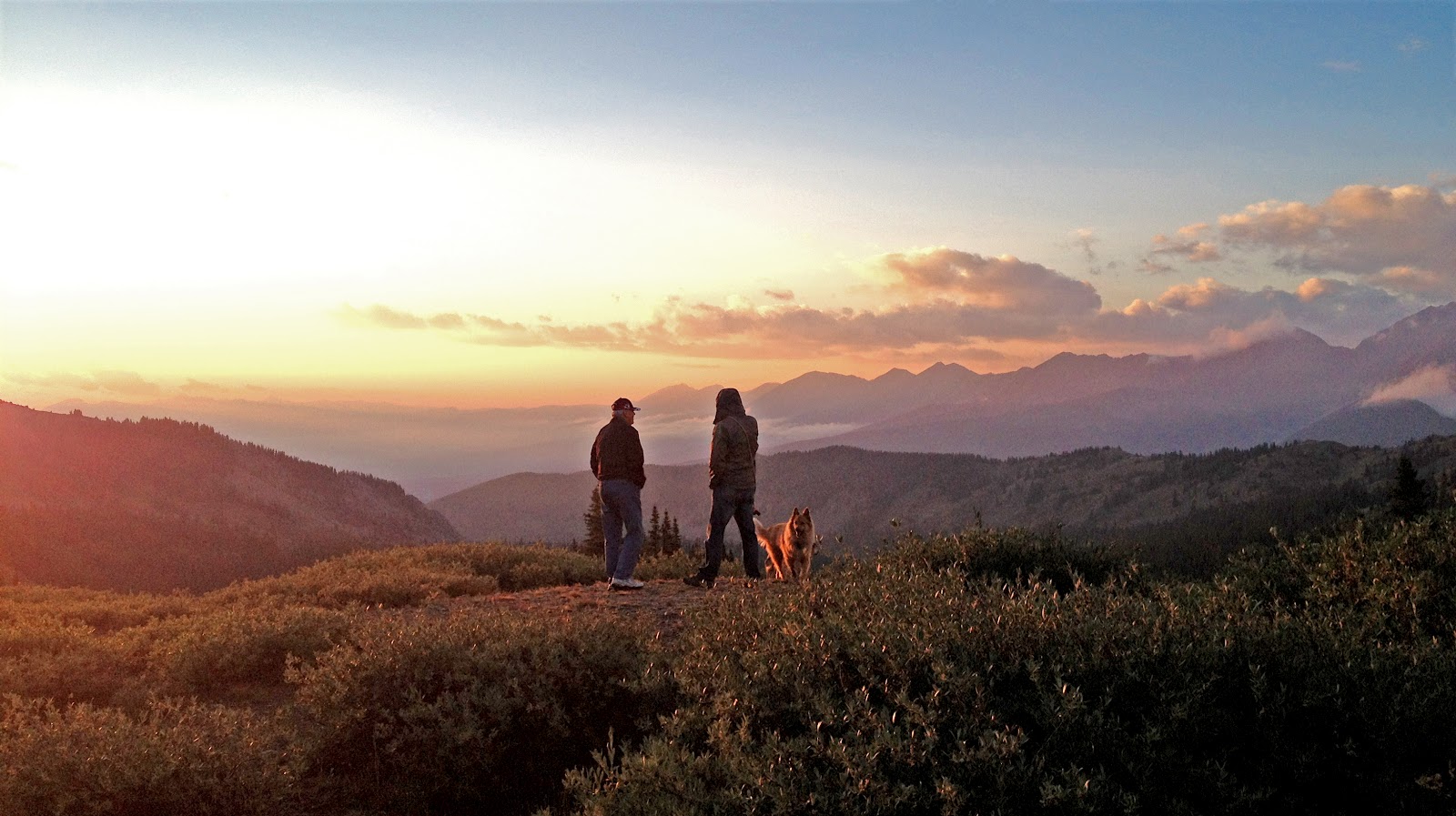
For ten days we explored Colorado and managed to not talk about cancer much at all, though I did find myself wanting to show my dad utterly beautiful things that I hoped would somehow flood into his psyche and provide a healing buffer. It's the best thing I could think to give him. So one night we drove up to Cottonwood Pass on top of the continental divide to watch the sunset. And it delivered.

I can easily recall a time when inter-generational tension kept family visits brief and polite. As a young man I would obsess about the imperfections of my family. The same was true for my wife Kae and her folks. On a car trip home after one beach vacation with her family, we had that conversation where you amaze yourself by identifying all the layers of dysfunction that somehow only you could see, but that mom and dad could not. We were pleased at our own insight and our resolve to live differently. After a hundred miles of working ourselves up, we decided we needed a good primal scream. So just as we came to the Sideling Hill Pass over the Allegheny Mountains, we rolled down our windows and stuck our heads out in the 70 mph wind and screamed ourselves silly. Ahead of us the road sloped downhill all the way back to our home in Chicago, where we couldn't wait to be. This primal scream became a tradition. We did it every year at that same pass. We'd do it even when we had an enjoyable trip, just because we liked traditions. Our kids found it confusing when they were little. As they got older they let us know we were being overly dramatic and embarrassing. Eventually we agreed and stopped doing it.

A half hour before it was time to drive my folks to the airport, my dad and I sat quietly together in the living room, both busy with our mobile devices. He was on his Nook, and I was texting a friend about an upcoming photo shoot. My mom walked in and said, "Put down those things and visit, we've only got a few minutes left!" My dad responded, "We've been here ten days. We're all visited-out." Which was true, so we all laughed, and then I drove them to the airport a little early.

After my folks left, Kae and I puttered around the house, cleaning up a little, adjusting to our home being just ours again; which was welcome, but also made us a tiny bit melancholy. A ray of late afternoon sun hit the kitchen counter and illuminated hundreds of fingerprints. Evidence of life, invisible from other angles. Twenty or thirty years from now (if we're lucky), it will be our kids worrying about us, making plans, stressing out, feeling sandwiched. And as they see us beginning to fade, it will feel unfair, and it will seem absurd, as it should. I looked across the room at Kae and asked if she wanted me to make a margarita. The sunlight on the counter was now on her. Tiny blond hairs on her arms gave her a halo.  "Why does any of this have to end?" I said.
And she knew exactly what I meant.

Monday, July 16, 2012

I hate when my dog kills a rabbit

Responsible, not guilty.


It's only happened twice in five years, but still.

The dead rabbit drooping from Derby's jaws looked exactly like the extra realistic toy bunny she plays with at home. For half a second I thought maybe that toy was a "gateway" bunny we should have disposed of, but I knew better. That dog is hardwired to hunt. So I did my best not to be mad at her. She never really gets a chance to catch anything other than flies, because I'm always calling her off. She's pretty good with the voice commands, if I'm there to make them.

I've heard lots of stories about dogs who proudly gift their humans with freshly killed field animals. Generous acts of tribute which confirm that dogs and humans share common values, but not a currency. But this wasn't like that. Derby dropped the still warm rabbit and wandered away indifferently, as if to say, "This broke, see what you can do with it."

I'm okay with the Circle of Life, but I hate to get it on my hands. There wasn't a way to make this killing meaningful. We weren't going to thank the Great Spirit and make a meal of wild hare on the trail, so I looked for a place to put the rabbit where some animal might make good use of it. The fields here are rich with coyote and fox who'd be glad to stumble upon fresh rabbit, if it would even last until dusk. Probably some hawk or raven would polish it off within the hour. So I found a well-trafficked place where all manner of paw prints converged down by the creek, and I laid the rabbit high on the bank nearby, wound side up.

Many of this season's rabbits won't make it until winter. This particular one may have been eaten within the month. The random intersection of my dog's trajectory and this bunny's poor timing is just an unnecessary example of something that was likely to happen anyway. What bothers me is the moral clumsiness of it, and that's my issue, not Derby's. So when we got home she received her usual treat anyway, and I vowed to be more attentive in the future, which is pretty much what I'm always vowing.

Hakuna Matata.

Tuesday, April 10, 2012

We're all going to die, so please buy my art.


Today I went to the Madden Museum in Greenwood Village, to judge an art show by high school students. The Madden is what they sometimes refer to as a "vanity" museum; in this case, an enormous glass and steel structure built to house the legacy of a rich guy. The building is in Denver's sprawling suburban Tech Center, where gleaming corporate high rises thrust up from the prairie next to an eight lane highway. The name of the building is the Pallazzo Verdi, and the road that leads to it is called Fiddlers Green. Mind you, this is in suburban Denver. All of this would be easy to dismiss as irrelevant cultural grandstanding by yet another wealthy cowboy developer, were it not true that many important museums are vanity projects (think Marshall Field, JP Getty, Guggenheim), and that the Madden Museum houses some truly noteworthy pieces.

Twelve schools participated in the Continental League Art Exhibit, which is designed to showcase and reward excellence in the arts. Settling into the show, I found the usual scratchboard drawings of cats, and melodramatic self-portraits, but also some truly unexpected departures into combined media, and honest stabs at self discovery. A couple of the pieces felt vital, as if they not only mattered to their creators, but that they had the power to matter to passing strangers. It occurred to me that this is the best any artist could hope for.

My favorite moment came when I rounded a corner and saw an especially nice Robert Rauschenberg piece from the Madden's permanent collection that had been pushed into an unlit storage area to make room for the high school art show. I'm not sure if this was some sort of afterthought, or if I had arrived before they were finished moving things around, but if it were my museum, I'd make sure my blue chip art was either on a wall, or safely out of sight. Nonetheless, something about seeing the Rauschenberg there was both sad and wonderful, like the sight of dethroned royalty. The fact that it still projected a powerful presence from its dark corner made me like it all the more. The most surprising thing though, was seeing that the museum was willing to completely redefine itself to showcase the art of young people, many of whom are just beginning to suspect that art might be something of consequence to them.

Whether my artwork, or that of any of my artist friends, or the kids in this show will end up in someone's legacy, or in a thrift store, is anyone's guess. A friend of mine was recently tipped off that a painting by a well-known local artist was available at a certain thrift store for only a few bucks. The painting was quite nice, not to mention large, but whosever hands it had fallen into had failed to recognize anything of value in it. My friend rushed out and purchased the piece, which had the effect of not only restoring the work to a place of dignity, but my friend got a killer deal on it.

I own a bunch of art I'd like to think is notable. I've come to possess most of it by trading my own work with artists I admire. I've also got a couple of pieces I love, whose origins are obscure to me. One is a tiny painting of a face in profile being spoon-fed the word "never." I bought it from a college student who had taken only one painting class. That's all I remember. I liked the piece so much it didn't matter to me that I was pretty sure the girl who made it might never make another painting. It certainly wasn't an "investment."  I bought the painting for the simplest of reasons: it spoke to me. It could be that no one likes this painting as well as I do. Good. Then it has found its home. The best works of art contain their own justification, some little insight, or revelation, or just plain weirdness that will keep them out of dumpsters. This is perhaps more belief than fact, but I'll stick by it.

When I was in high school I made a painting of an old jalopy rusting under a tree and gave it to my Grandpa Baldy for his birthday. This was during my surly teen years, so any form of spontaneous generosity was a huge relief to my whole family. The painting was overtly sentimental and not at all original, but competently done, at least. I forgot about it entirely. At my grandpa's funeral a few years ago, the family presented the painting back to me. They told me it was Baldy's favorite painting (his only painting as far as I know), and then they took pictures of me holding it, which felt especially weird.

It took a few years, but eventually I found the exact right way to dispose of that painting. This is when I lived in North Carolina, where if you want to get rid of anything other than ordinary household waste, you have to drive it to the dump yourself. I used to go there a couple of times a month with various things that couldn't go out to the curb. The dump had an old gate keeper that wore the same brown Carharts every day. His job was to unlock the gate in the morning, keep an eye on whether things were being put in the proper dumpster, then lock the gate up at night. In his little guard shack I noticed he'd rescued a lot of objects: a vacuum cleaner, an old bendy pole lamp, a calendar picture with the months ripped off. On the day that I took the painting, I made sure it lay on the top of the "Misc Non-Metal" dumpster, face up and clearly visible. On my next visit to the dump I was happy to see it hanging in the guard shack, right where the calendar used to be. I knew the gatekeeper and could have just given him the painting directly, but I suspected that in his world, reclaiming the painting himself would have given it the right value.

Remember that maudlin 70's song Dust in the Wind? It's one hundred percent true, like it or not. Sooner or later, you, me, and everyone we've ever crossed paths with is going to vanish from this earth. This won't require an apocalypse, just the normal limits of mortality. In the big picture, this is all going to happen rather quickly. All of the things we've owned and made precious, all of the photos and half finished novels we've boxed away, all of it is going to be sorted through by people who won't have quite as much empathy as we'd like. Even our loved ones are going to throw most of our favorite things away.

The things you create, and the art you own (if any) will survive on their own merits. Some pieces may acquire rich histories and travel the world, others will slowly flake and peel in landfills. Either way, what happens is pretty much out of your control. Maybe you will be lucky and will get to leave a legacy. Maybe you will be especially lucky and have children who give a rat's ass about the same things you do. But for the rest of us, if art is going to matter, it will be right now that it does so. It will be because the things we create, and the objects we surround ourselves with help us discover who we are, while it still matters. So do what you can to buy the art that seems like it should belong to you. Especially if it's something that reaches into your psyche and gives it a good tweak. These are the pieces that will make your life just a little richer if you get them into your home. And some of them are going to keep working hard, delivering whatever experience they were designed to deliver, and will do fine on their own, long after you're gone.

Monday, April 2, 2012

What The World Needs Now...

Is another folk singer, like I need a hole in my head."

So goes the song. And that's pretty much how I feel about entering the blogosphere.

Recently my friends have been encouraging me to blog. I'm guessing this is a good idea since my Facebook posts have been getting rather long. And since most of my friends are reading at work, on their employer's dime, it's only fair to them to let them know what they are getting into. I'm flattered that my meanderings might be of interest long enough to compromise someone at their job. That's something of an accomplishment for me.

When I think about why I write and what I want this blog to be about, I think it can only hope to be about nothing in particular, but that it should be crafted in a way that it becomes undeniably 'something.' I know how contrived that sounds, but it's my mission statement, for better or worse, plus it's the only way I really know how to write. And if it makes you late for a meeting, then I'm probably doing my job. So here then, is a blog about art-making, Dog walking, wine drinking, divine and secular intervention, and whatnot. Especially whatnot.

Also, I've reposted some of the Facebook entries from the past year that I've really liked. Thanks to everyone who has caused me to believe this is worth the effort.

Enjoy.

_m

Date With a Power Saw


In 1985 I painted my first big painting. It was four feet tall and eight feet wide, and weighed close to 60 pounds. I know this because I once put it on a bathroom scale. I made a bunch of paintings like this, all unwieldy and cumbersome, because a college professor had convinced me that painting on wood panels was the best solution for large scale work. Stretched canvas, it seemed, was prone to warping. What he didn't tell me (or I didn't hear) was that I should make damn sure the painting was going to be spectacular before I went to the trouble of making it huge.

Sadly, over time it became clear to me that this painting wasn't very good. But it also wasn't very bad. And so it became increasingly troublesome as I moved from lofts to apartments to houses in different cities and states. I never hung the painting. You've never seen it. It isn't on my website. It lived mostly in a great big shipping box. I'd only look at it once every three or four years when I needed to move. Each time I peeked in its box, I half hoped to be surprised by my creation, as if I would finally discover something amazing that had previously eluded me. But each time it remained a solidly mediocre, four by eight foot, sixty pound thing - now with a light dusting of mildew. So today, while spring cleaning the garage, I decided to deal with it. I un-wedged the painting from behind a stack of ladders and scrap lumber and piles of other not-so-good paintings. I peeled back the U-Haul quilt and exposed my painting to the full light of day for the first time in years. It still disappointed me. The only surprise was that every half-good thing about it had resurfaced in other paintings I've done since then. Finally the thing had no real purpose left. It was time for the power saw.

I know plenty of artists who manage to recycle the work they don't like. They paint over it, or incorporate it into something else, or raid it for parts. Still others find comfort in the idea that all works of creation are part of an ongoing personal journey that has intrinsic value for the creator, regardless of whether the works are 'good' or not. In my case, I may recycle the ideas in a work of art, but find I'm too troubled by the physicality of a mediocre creation to let the work survive another incarnation. For those of you who find the materiality of art problematic (or the proliferation of man made 'things' in general), you'll know what I mean when I say the poor choices that result in a crummy work of art have a multiplying effect on the very materials used to bring the work into existence. These objects resist transformation. This is why I'm happy to own a variety of power saws.

As I halved, then quartered, eighthed and finally sixteenthed the painting with my saw, I found myself cutting the pieces into increasingly irregular shapes, as if to outwit some imaginary trash picker who might be curious about piecing my big failure back together. In my cosmology, this person would somehow have a fine arts degree, and would be bitter about the circumstances that led him to puzzle with other people's trash. From sheer spite, he would go to great lengths to reassemble my object of shame for his own amusement. So for this reason, I disposed of the fragments in separate dumpsters.

And now for the benefit of those of you who may be embarking on a similar portfolio cleansing, I offer the following tips:

Only careful deliberation will make clear which of your 'iffy' works should travel any further with you on your journey. Once you're sure which ones are crying out for the landfill, you'll need a good saw. I recommend the reciprocating type, like a Sawzall. These allow for a variety of curved and angled cuts, and with the right blade you can make short work of even the toughest materials. Plus they are fun to work with.

Before you go 'Shiva' on your inferior creation, take a moment to make peace with it. If its really bad, you may like to forgive it. I'd recommend you have a beer while doing this, but only one, since you'll be working with power tools. If possible, you'll want to set about this work on a sunny day. If it's cloudy you might get sad about your life, which is pointless and undermines the task at hand. Also, don't be listening to the Cure.

Next, to avoid cold feet, be sure to approach the work from the back side as you tear into it.

Finally, once your piece has been rendered asunder, consider disposing of it in a dumpster that will allow some anonymity. You can find these at your nearby mall. Just look for a store that's in bankruptcy, like a Borders. Chances are good there will still be a dumpster round the back.

When you are finally home, try a little light TV watching. You must steadfastly avoid writing poetry, or blogging about your day. These activities could result in something else you will later need to destroy.

For those who find my approach to purging obsessive or melodramatic, remember that the creation of these objects required many hours spent physically manipulating materials. You literally wrestle your creations into being. It's only fitting that the act of decommissioning them as art objects should take a similar hands-on approach. Simply tossing a work into the trash doesn't require the full participation by the artist in one of the most important steps in the creative process. At least this is how I justified taking an entire afternoon to reduce my big painting to what resembled a pile of roofing shingles from a Dr. Seuss house. Besides, It's only by actually taking your work apart that you can talk about 'deconstruction' and have the slightest clue of what you really mean.