Sunday, April 21, 2013

Amateur philosophising on the occasion of my 55th trip around the sun


I've never been that good at looking into the future. The next couple of weeks are somewhat clear to me, but after that it's completely fuzzy. I'm not talking about goals. We can all pack some imaginative details around our goals so that they become palpable, allowing us to daydream about this or that vacation or career change. But that's not seeing the future. Sometimes, when I look at my reflection and find an extra set of lines around my eyes, or see the way the skin under my chin is starting to droop, I think I can see it, but that's not the future either. That's the present. Still the mirror seems like a good place to start. Where else could you expect to find it?

Today is my birthday. This is my fifty-fifth year of being a distinct, conscious, living and breathing person. A fact that is somehow still unimaginable, no matter how I try. I don't know what it means to be 55, but it seems like it ought to mean something. So far, all of the big emblematic birthdays: 30, 40, 50, have all turned out to be false alarms. I've dreaded each of them in turn, because like all of us, I was taught to; supposing each of those ages were milestones on a march into inevitable irrelevance. But like Y2K, they are just days you look back on and feel silly for fussing over, if anything. 

I may be wandering into pure B.S. here, but for the possible benefit of the one or two young people still indulging me, I will offer the only thing I have in the way of insight about aging. It's nothing close to wisdom, just a sort of spoiler alert. It is this: The person you are right now is the same person who will wake up in a 55 year old body someday (hopefully), and you will not be prepared for it, despite your best efforts. Sure, you'll adjust to your bad knees, or the extra 15 pounds, or the increased frequency of getting up to pee at night. And by sheer discipline, you may even decide that you "accept" the effects of aging. Good for you. Nonetheless, one day you will wake up and realize you are finally middle-aged, and this realization will feel sudden, even if you've seen it coming. It may also leave you feeling insulted, because you have never stopped thinking of yourself as being vital, and in-the-moment, and because the core self is entirely unallied with any age or point in time.

When I was three years old my mom caught me melting Crayola crayons onto a register grate on our kitchen floor. It turned out that was a bad thing, but in the moments before I was made aware of that, I experienced the pure joy of exploration. I can still feel the amazement of watching the crayons slowly sagging across the grate then dripping down into the blackness. One by one I melted them onto the register until they were gone, and the smell of wax alerted my mom to the fact that I'd been left alone too long. In fundamental ways, I'm still melting crayons on a register.

Each of us crafts a sense of self from the sum of all our experiences. I am still that curious toddler and also the insecure 12-year old who can't yet talk to a girl AND also the know-it-all 25-year old who can't stop talking, plus whoever else I've been since then. We don't progress through life stages as much as we accumulate them, and each stage in turn informs our sense of self. But the thing that is fundamentally "you" - your core self - transcends age and experience. It sits at the root level of your personality and simply observes, like an unblinking eye. Everything we decide to do, consciously or unconsciously, is in reaction to those core observations. Our habits and passions, our coping strategies, creative proclivities, even our humor proceeds from that inner observer, the true self.

The first time I realized there was a more fundamental sort of self that sat back further in the depths of my own psyche than the conscious mind, was when I was recovering from amnesia several years ago. I had been hit by a speeding drunk driver while riding my bicycle in Chicago. I was briefly hospitalized with a concussion and amnesia. Hospital staff would have let me go home sooner, but they needed to release me into someone's custody who could keep an eye on me for a couple of days. The trouble was, I couldn't remember the names or phone numbers of any of my friends or family, and because I didn't yet have a mobile phone, none of that was at my fingertips. Eventually I was able to think of a friend to come claim me. When I was given the release form to check out of the hospital, I was terrified to realize I had no idea what my signature should look like. Memory recovery was sporadic over the next couple of weeks. One day I panicked to discover I was riding a CTA bus with no idea where I was going or even what street I was on. I jumped off at the next stop and stood there staring at the street sign trying to make it mean something. Slowly the world came into focus and I remembered where I had been headed, and why. I wrote it down on a scrap of paper: "going to work," then waited for the next bus. It was a depressing time. Each blank spot came as a terrifying chasm of loss, no matter how trivial the missing memory would otherwise have been. The effect was brief but overwhelming. Each time it happened I was aware that it was happening, which meant some core aspect of my self was doing critical assessment and seeking to re-integrate, even if I couldn't have told you my name. That's the core self I'm talking about. The Me that's in charge of being Me. And its more than a little bemused by this whole aging business. I don't expect that will change any time soon, but since I'm in good health overall, then there's no rush to accept it. Not yet at least. It's also comforting to know about that unblinking eye at the center of me, who could care less about age, and whose job it is to simply watch, and discover, and to be amazed.

Friday, March 1, 2013

What if we don't make it?


That painting is a good one. You are sure of it. So you post it on Facebook and immediately begin refreshing your browser every thirty seconds hoping for the Like's to start rolling in. Ten minutes go by. Only two Likes and no comments. Damn. You check the time and realize all your friends are probably still at lunch. Bad Facebook timing. You should have waited til 2 o'clock, when everyone is back in front of their computers, but they are drifting and distractible, no longer completely engaged by the demands of their afternoon.

Half an hour later your computer chimes and you dash out of the bathroom with your belt still undone. You've got seven Likes and three comments. Whew. You may not yet be Earning Big Money, but now it seems at least possible that you are not a failure.

The creative temperament has endless triggers for self-doubt and a constellation of worries: What if my prices are wrong and nothing sells? What if nobody goes to that site to vote for my song because it's two clicks away? What if I never get that book contract and end up self-publishing, and only sell a handful of copies to my friends and the co-workers who feel obliged? Why the hell am I doing this?

It's a cruel fact that in an era when the output of blue-chip artists like Damien Hirst and Jeff Koons is traded by the global One Percent as an esoteric futures commodity, that so little money actually changes hands down here at the "emerging" artist level. My own anxiety about never making a decent living from my artwork forces me to rely on sleep aids more nights than I'd care to admit. And yet by some standards I'm making it. I've got a couple of buddies who claim I'm living the dream. Why? Because I quit my career and am selling art for nearly unaffordable prices at a grown-up gallery. And because I have my wife's blessing. But if they knew how few paintings actually sell, or noticed that I've been wearing the same pants to every art opening for six years (thanks to the style longevity of Brooklyn Industries), I would drop right off their list of enviable persons.

Like most anyone reading this, I'm a drop in the bucket now referred to as the creative class. A demographic ghetto of dreamers slogging it out the best we can, pouring other people's lattes, building websites, seeking a tolerable work-life balance that keeps our little creative flames kindled just long enough to draw one more picture or write one more song. We make art because we don't know how to stop. Or because our critical reasoning just isn't that good. Or just possibly, because it saves our lives.

My friend Dylan Scholinski runs an art workshop called The Haven Youth Project that seeks to prevent suicide through creativity and self expression. Many of the kids that go through his program are hanging onto this life by a thread. For them, the transformative power of creative expression is essential to their survival. I try to think of this when I get bogged down by the cynicism of the art world, or when a client takes too long to pay.

I can't say art ever saved my life, but I doubt I could live without it. It's been a refuge since I could hold a crayon. It's also been the only thing anybody ever wanted to pay me for. I sold my first drawings in fourth grade. Some kid noticed I could draw, and he paid me his lunch money every now and then if I'd make pictures for him. He would stand over my shoulder and say, "Put a horse over there. And a barn. Can you do a tractor? Good. That's enough. Now don't sign it!" Turns out he was taking the drawings home to his parents, claiming he'd done them. Before long, word came down from on high that these commissions were to cease. I didn't ask questions. But by then the word was out. Kids knew I could draw. Toward the end of that year I was forced by a bully to do pornographic drawings of Peanuts characters. This bully had already beat me up once, so when he said "Draw a picture of Linus and Lucy doing it," I did. But at age nine I was fuzzy on the mechanics. It was hard enough to draw cartoon characters correctly with their clothes on, but to imagine them naked, with adult sexual organs and in positions I wasn't clear about, was a mind boggling creative challenge. Perhaps the hardest of my life. The bully was there to help with the details. The only thing I thought to say was, "Shouldn't it be Charlie Brown instead of Linus?"

You'd think this assignment would have been humiliating. It wasn't. On the scale of childhood woes, it was way down on the list compared to getting beat up. I took it in stride, and delivered the work. I should have known from those early experiences that I'd do well in advertising, but it didn't become clear for decades.

By the time most of us have decided to make a go of a career in the arts, our heads are filled with ridiculous tripe about what making it means. The metrics for it's measurement, the bohemian fantasies we indulge, the value we place on this or that achievement are all contrivances that will turn on us when the work stops selling. When the world says "meh" to your latest show, inevitably some form of the question "What if I can't make it?" will cast its shadow across the work you thought you liked.

At some point you may become aware, or you may decide that this is the wrong question entirely. At the risk of sounding moralistic, a more useful question is something like "How can I better serve the talent I have?" It may seem old fashioned to think of your creativity being saddled with any sort of obligation. Who would you be obliged to?  In a recent interview, 86 year old singer Tony Bennett claimed the secret to his career longevity was commitment to honoring his talent. Years earlier when he had "gotten into the drugs," Bennett was warned by Lenny Bruce's manager that he was headed down the same path as Lenny, because he was "sinning against his talent." Tony got clean and stayed that way for five decades. In this frame of thinking, the artist's indebtedness is fundamentally to his or her own talent, rather than that talent being something the artist exploits.

The idea that artistic giftedness bears witness to creative forces beyond ordinary human enterprise is persistent across time and culture. Rumi was onto it, so was William Blake, and so is that kid next door flailing away on his guitar in his parent's basement. If creativity is something that can be tapped into or channeled, then it demands a certain respect, if not reverence, and it follows that those of us who have access to it should approach it with discipline if we wish to have it make a regular appearance in our studios. I don't mean for this to sound romantic or mystical. At it's most stripped down, this obligation is about being in service to your own curiosity, and to pursuing it with rigor.

When I was a kid, a friend of mine and I wandered the banks of a river in Kentucky one afternoon. For whatever foolhardy reason, at some point we decided to weave little rafts from dried sticks and leaves, which we waded out into the river with, then lit on fire. We held them at arms length until the flames were well established, then launched the blazing crafts into the swift stream and watched them steam and smoke their way over the rocks and riffles until they drifted out of sight and were presumably destroyed by the river, since the woods around us never erupted in flames. We stood there in the river for a long time. Later we didn't talk about it. It would be years until I encountered the word ineffable, and when I did things started to fall into place.

At the end of the day we all have to make our best guess at what artistic success is going to mean. Attempts at values-clarification and living intentionally, or honing your own personal "brand" may get you part way there. Facebook Likes aren't meaningless indicators either. But success is a moving target, and we'd best be comfortable with the directions changing when we are halfway there. One way or another, I'll always throw my lot in with curiosity and the pursuit of the astonishing. It may be a little old fashioned to be guided by such transcendental values, but in some way I seek to invoke them in everything I create. My best hope is that each painting I make will be a little flaming raft disappearing around a bend in someone's river. It's a goal anyway. I may not ever Earn Big Money, but I'm all in with this journey.

Saturday, December 22, 2012

Bad Human


I knew it was going to be OK to climb Chief Mountain to watch the sunset on the winter solstice. Coming down at night would be a cinch under a cloudless moonlit sky. The packed snowshoe tracks would be easy to follow even without headlamps. What never entered my mind was the trouble my dog was going to have with ice collecting in his paws. People always laugh when they see a dog in boots, but in certain situations they are indispensable, like climbing snowy mountains. Unfortunately, we left the Fido Footware at home, and since our guy did alright on the way up, we figured there was no cause for concern.

On our descent the temperature dropped just enough that ice balls were forming in the thick fur between my dog's toes, which made it painful for him to walk. We'd stop every few dozen yards or so to help him de-ice, but with a couple of miles to go this method was becoming untenable. After a while it occurred to me that I should try to carry him. I gave Kae my backpack, and she helped lift our 60 pound pooch onto my shoulders. I carried him "fireman" style, which left him free to knee me in the head once or twice, but he rapidly figured out what was going on and settled in for the tippy ride. At first I was pleased with how much ground were able to cover quickly. Gravity was on our side. Soon, however, we came to a dense section of woods with low hanging branches. After misjudging their height and banging my buddy's snout a couple of times, he lost confidence in me and began to squirm. We collapsed in a soft patch of snow as I protected my face from his flailing claws.

We resumed our rhythm of paw cleanings at 20 yard intervals for the remainder of our ordeal. Once or twice the moonlight through the trees caught my attention, but only later was I able to recall how beautiful that had been. Somehow we made it back to the trailhead, and I can say I've never been so happy to see our car. The moral of this story is self-evident, so no lectures, thank you please. Suffice to say the dog boots are in the car now, ready for our next adventure.

At home in the yard my dog leapt against me and almost knocked me down. He loves punking me like that when I least expect it. Leaping is a trait most people like to train out of their dogs, but because it has something to do with expressing delight, I'm lenient with it. And last night it's how I knew I'd been forgiven.

Thursday, December 13, 2012

The Dream Argument

José Argüelles' Rainbow Bridge
I have no idea where my wife wants her ashes scattered.

I'd wake her up to ask, but even in my insomnia-addled brain I recognize this isn't a good idea. So I lay there and mull it over quietly. Soon it occurs to me I don't know what I'd do if my dog bit some kid and the Aurora police came to take him away. It doesn't matter that I don't live in Aurora. Somehow those dog-snuffing cops would show up on my doorstep anyway. I'm giving this some serious thought when I realize I have no plan whatsoever for when the planet Nibiru swings around from behind the sun and slams into planet earth, ending life as we know it, only a few days from now.

If you suffer from both insomnia and any sort of anxiety disorder, you will know that the place they intersect is not a pretty one. Tiny seeds of fear, left unattended by the demands of the waking world bloom at night deep in your amygdala. They take on texture and substance in vivid dreams, alerting all areas of your brain to the presence of a real problem. Soon you are awake enough to give these cascading worries your full attention, and no matter how still you lie, or what sort of mental exercises you practice, you will not be going back to sleep. Never mind that all of these troubles are laughable by the light of day. There are just enough threads of reasonability tethering your phantoms to reality that they will make you their servant for the remainder of this otherwise quiet night.


In full disclosure, it probably was a bad idea to watch a documentary on 2012 Doomsday Cults directly before going to bed last night. I had not known there are so many people hiding in caves and bunkers all over the earth right now getting ready for something big to happen on December 21. Some of these people have quit their jobs, withdrawn their money from banks, and bought cheese and beans and ammunition. But not all of them are the kind you see wearing camo at the Walmart when it isn't hunting season. New Age author José Argüelles, who brought us the Harmonic Convergence, is organizing a simultaneous worldwide meditation event that will use the combined power of all the like-minded meditators to literally deflect apocalyptic solar flares away from the earth and channel them into a rainbow bridge that arcs from pole to pole. And if that's not your style, there's even an Arizona developer building fully stocked underground condos in a converted MX missile silo at 900K a pop. If things are about to get really bad, those folks are set to ride it out in style.

Cultural variations aside, these Doomsday clubs have a lot in common. Their thought leaders are all relentless self-publishers, whose source material typically includes aerial photos of crop circles, secondhand interpretations of Mayan tablets, and wild reinterpretations of ancient Sumerian astrology. What they lack in scientific rigor, they make up for with passion and imagination. These groups also share a reliance on social media to organize, raise funds, sell survival stuff to each other, and generally keep the fear fires burning hot. But the shared trait that surprised me most is their utterly pragmatic approach to the end of the world. This isn't your grandfather's Armageddon, where Good and Evil have it out one last time in a cosmic Battle Royale. This is going to be an entirely secular cataclysm, where only the prepared survive. Sure, some of these folks will quote the Bible or some other sacred text, but they aren't concerned with righteousness, they simply want to outwit the prophesies.

It's easy to assume 2012 survivalism appeals primarily to the socially marginalized. A sense of estrangement from the natural order would add even more to their numbers. But that doesn't explain the mass appeal of this latest end-times scenario. The search term "Doomsday 2012" returns over 72 million pages on Google. I can't help but wonder if the desire for disaster isn't a projection of a culture that yearns for global catharsis, even if it came at the expense of millions of dead people. Visit any doomsday website, and once you get past all the predictions of catastrophe what you find are twisted messages of hope. Many use the word "rebirth," fully acknowledging the word implies lots of blood and pain.

I find the obsession with 12/21 to be a culturally constructed "straw man" that facilitates us fantasizing about surviving an instantaneous cataclysm, while distracting us from the mundane and depressing effects of things like global warming, which is its own sort of slow-motion apocalypse, but much more hopeless in its way. That said, there is something to be admired in the folks who get hands-on when responding to these potential world-ending scenarios. Agreeing on which are the real threats is the hard part. Some of us stockpile food and weapons and head underground. Others drive hybrids and put solar panels on their roofs. Either way, it's doing something that makes the Bad Situations seem a bit more manageable.


There is an ancient philosophical conundrum concerning the illusory nature of reality called the Dream Argument. Plato and Aristotle both took it on. The crux of it is that since we do not know we are dreaming while we are in a dream, and yet our dreams are filled with the same sensations we experience when we are awake, how then can we trust those senses to tell us when we're awake? Or said even simpler, how do we know we are ever awake? French mathematician-philosopher Descartes said that while our senses are not particularly trustworthy, reality itself is separate from us and to some degree knowable. Later philosophers focused on the social construction of reality and the practical necessity for a consensus on what is real. So it seems that to this day the jury is still out on reality. What is certain is that our anxieties invade our dreams, and our dreams in turn create images that haunt our waking world. What separates dream from reality is less a door than a passage through fog.

If the Doomsayers turn out to be right, then it won't be canned provisions and weapons I'll regret not stocking up on. It will be sleeping pills. At the end of the day, I have enough trouble outwitting my own petty demons, and staying on a predictable sleep cycle.  I can't trouble myself with phantom planets. Besides, I'd rather rest in peace with the skeptics than spend the rest of my post-apocalyptic days roasting rabbits I snared myself on the bonfires of Ikea furniture while fending off marauding bands of feral suburban teens. You can have that world. If I can trust anything at all, it is that the NASA scientists are dead-on, and they all say not to sweat it. So I'm not sweating it. There may come a day when they let us know we can start to worry about this or that comet or solar flare, until then my money is on December 21st being an entirely ordinary winter solstice. The chilly, partly cloudy kind, with a killer sunset. So to speak.

Monday, September 24, 2012

Beach Blind


 She was nudged by a manatee. She was a child raking clams in shallow water, somewhere in Florida. It was 1980. The manatee bumped her just slightly, whether the result of curiosity, poor eyesight, or as some sort of message. She turned around to see the huge leathery sea cow gliding off into deeper water.

Until this moment the girl does not know manatees exist.


This memory has become important to her for a variety of reasons. Now, as an artist, she has decided to tackle the telling of it in the form of an experimental performance piece that will put performers inside sculptural constructions, out of which they cannot see, as they "kind of rove slowly around the floor" of the gallery. She says the piece will be about blind faith. The title of the exhibit will be "Half The Floating World."  It will be a group show that she will curate. She invites me to create a piece for it.


I read all this in an email, on my smartphone, while laying on a beach.


It is day nine of our annual family vacation on the eastern shore of Virginia. All week long siblings, children, girlfriends and boyfriends rotate through our rented beach house. Days are spent getting tossed around in the vigorous surf until exhausted, followed by a stumble up the sand for a nap under the umbrella, or to fall asleep with a good book in a beach chair designed to last exactly one week. All of this set against the music of crashing waves and sand-muffled sounds of children playing. In the evenings, we make fantastic meals for each other, drink uncomplicated wine and tell new variations of the same old stories. It's idyllic in an unambitious, middle-class way, and I love it completely. But it makes it hard to remember my life back home, and by day nine I have had enough. Not of the family, but of the opiating effects of the beach. 


I'm thinking about all of this as I struggle to lift my head from a nap on the sand. I am stretched out beneath a big striped umbrella, covered with sunscreen, but I feel the UV making me red anyway. From where I lie, I can see the sun through two colored bands of umbrella fabric. When I close my right eye the sun is a fuzzy pink disc. If I close my left, it is green. I blink back and forth a few times making the sun jump between colors until my mind reconnects with that little grain of anxiety that brings me all the way awake. Time to head back into the water.


Every year I come out here thinking I will use this unallocated free time to start some new project. Maybe rethink my website design or do some sketches for new paintings. Once or twice I've actually tried to work on freelance design jobs out here. But every year I come back empty handed. Rested, but dull in the head. Rudderless. Vacated.


My friend's email is a welcome intrusion as I begin to plot my re-entry into real life. I know the show she is planning is likely to be good. She's a visionary whose career is on a bit of a roll. It can't hurt to be a part of this, whatever it turns out to be. I re-read her message to make sure I've got the title right. "Half The Floating World." I have no idea what this means, or how it connects with blind faith, but I love something about it. I'm certain that when I talk to her she will fill in the blanks, but in the meantime I know the puzzlement and wonder those gaps create are exactly the places creativity thrives. But blind faith? I have no idea what this is. I'm pretty sure everyone thinks their faith is informed, regardless if it is faith in a god, or in a partner, or a country, or even that your car is going to be there where you left it. But blind faith sounds risky. Unhinged. Foolish. I'm trying to think of a good example. Even in that bible story where Jesus calls Peter to step out of his boat and come walk on the water with him. Was that blind faith? Probably not, since Jesus was already out on the water, suggesting some new faith-enabled feasibility was at work. Either way I'm guessing Peter's fingers were crossed as his toes hit the water.


Finally on my feet, I decide to take a walk to give this creative challenge some time on the front burner, but my brain is over-rested and fogged-in by salt air and mid-Atlantic heat, and the ideas just aren't there. What if I don't come up with anything? This is what the fearful part of my brain always asks. Its tiny voice is there to remind me I might fail. I don't resent it, or seek to suppress it, because it's looking out for my best interests. Besides, there is another stronger part of me that knows I will find a creative solution. The same way I don't have to look at my feet when I walk. It just happens, thankfully.


I'm headed down the beach without my glasses. Normally I'd be wearing them for any viewing beyond arms length, but the blowing sand is hard on the plastic lenses, so I leave them in my beach bag. Until now I've forgotten how truly bad my distance vision is. All shapes have their edges rounded off, like beach glass, and radiate faint halos. I decide it's okay to keep walking, carefully, since I can still make out where all the people and umbrellas are. I look back at my own and memorize its cluster of colors. I tell myself I like the challenge of negotiating this impressionistic scene, except the lack of detail is beginning to make me paranoid, and with good reason. I freeze as I discover I've wandered into a congregation of kite fliers. I should have remembered they were here. They are mostly children, from what I can tell, and the blurry colors just overhead are their kites. A stiff offshore breeze keeps the kites flying at a low angle, the highest ones only thirty feet up. I know, without seeing it, that the air just above this expanse of sand is bisected by invisible strings. Strings that would be hard to make out even with 20/20 vision. It's hard to tell how many of the people around me are flying kites. Ten, twelve? Better to count the kites. At first I find eight but then realize two are multi-part contraptions, so six it is. Good. Now, how to work out a passage away from them that doesn't involve crashing some kid's kite or slicing myself on the taught strings? The next few minutes are spent cautiously zig zagging between kite fliers, and willing—without effect—for the strings to come into view.


At last I make it down to the water's edge, uninjured and unembarrassed. The way back up the beach toward my family is reasonably apparent, so I take a minute to jump in the Atlantic and cool off. I have completely forgotten about trying to have a creative idea regarding blind faith, or anything else. At the moment, I am at least part of the floating world, but which half, I cannot say.


Shadows drift below me in the cloudy surf, but even without corrective eyewear I know they are shadows of my own creation and not to be feared. Further out, just past the surfers, dolphins ply the whitecaps in the afternoon sun. Beyond them, the occasional marlin is unlucky in it's choice of prey and lands thrashing on the deck of a boat. And miles further out, Right whales migrate south along the rim of the underwater Accomac Canyon. These waters are rich with pelagic mysteries, some bumping us, moving us along, some capable of tearing us limb from limb. But there are no manatees here. We are too far north.

Back at our beach enclave I locate my glasses case and peek inside at the unsanded lenses. Among the many things I am thankful for, these glasses are at this moment right on top of the list. But I do not put them on. I snap the case closed and stow it back in my bag. I'm okay without them for now. I stretch back out onto my towel and close my eyes under the striped umbrella.

Thursday, September 6, 2012

White Wires

A father tosses a ball with his son in the park at the end of my street. A scene so ordinary it should go unnoticed, except for one detail. The father wears white earphones and seems to be listening to some sort of i-device. At first I guess he may have taken a phone call, and needs his hands free to continue the game of catch, but as I watch I noticed certain gyrations in between throwing and catching that suggest the dad is grooving alone to himself. There is no conversation between father and son, just the back and forth of the white ball against the green of a late summer afternoon. The boy, perhaps six, wears a comically oversized mitt which only occasionally helps him locate the ball.

When I walk the multi-use paths around my newly designed "urban infill" neighborhood, the people I meet almost invariably wear white headphones. It doesn't matter whether they are running or pushing a stroller, they all seem mid-workout, so I know there isn't going to be any chit chat. An unintended convenience for the wearer of the white wires is that they can be spotted from a distance, thereby signifying unavailability. It's a fair-warning of the listener's near-total disengagement from the social sphere. Though they may be in a public place, their behavior suggests preoccupation with something utterly private. You're lucky to get a "hi" out of anyone with headphones on, and you're supposed to know that ahead of time.

Headphones used to be black, with maybe some "chrome" accents. It was this way for decades. When Apple introduced the iPod the wires were suddenly a bold white. Apple had bucked convention right down to the tiniest detail. Now it's hard to find a set of earphones that aren't white, not that you would want them. Even the sketchiest of off-brands imitate the white Apple ear buds.

On my way down Mount Shavano in Southern Colorado earlier this summer, I was surprised at the stream of white-wire-wearing solo hikers that were on their way up the mountain. Though it's not a technical climb, any hike up above 14'000 feet in elevation would suggest you have your wits about you and pay close attention to every aspect of your environment. Particularly when you've gotten a late start, as these folks obviously had, and storm clouds have crowded the sky.

In full disclosure, I'm no stranger to the use of headphones. Though I'm irked by some of the sociological affects of headphone wearing, I know how critical a high energy mix can be to powering through a tough workout. I'll also admit I've dropped over a hundred dollars on a set of top-end ear buds just so I can get the extended audio frequencies a high definition source can deliver. Furthermore, I've worn the white headphones in public when I 'm not listening to anything at all, just to be left alone. And, outrageously, I have used them on top of a mountain. Which I can explain.

Even the easiest fourteeners can be extraordinarily demanding. When I first started hiking them, I noticed that lots of climbers perform some sort of ritual, or reward themselves with something special on the summit. After climbing a non-standard route on Gray's Peak in Colorado a few years ago, one of my climbing buddies took a kite out of his pack and flew it from the peak. Another produced a rotisserie chicken from her pack, which she proceeded to share with other hikers. I have seen flasks passed and cigars smoked. A friend of mine even reported seeing two young men with wooden Corn Hole game boxes strapped on their backs struggling up one peak. So it would be unremarkable to admit I've listened to my iPod on top of 14,196' Mount Yale, in the Collegiate Peaks Wilderness. I mention it simply because the music I listened to led me into something of an ecstatic state, which I'd never quite experienced before.

It's no coincidence that every religion I can think of equates mountains with holiness, or states of spiritual bliss. You might say it's all just the effects of endorphins and the thin air, but until you've gotten yourself up to a high summit under your own power, and experienced the intoxicating numinous weirdness of just being up there, you'll only be able to guess at its mechanics.


The music I chose to accompany my stay at the top of Mount Yale was Carl Orff's O Fortuna, a particularly over-the-top piece of mid twentieth-century classical music. Purists who resent pop culture's appropriation of this piece for everything from movie soundtracks to video games, dismiss it as high camp. It's sort of the Bohemian Rhapsody of classical music. But no matter, listening to a piece of over-the-top music on top of a mountain requires no justification. From the opening choral blast the effect was overwhelming. That critical little voice in the back of my head which rarely shuts off, tried to remind me that this experience was a contrivance. But the voice quickly fell silent. The world tumbled away in every direction. Far below, the shadows of cumulous clouds drifted across the forests. I did a slow 360-degree turn as the names of familiar peaks in the distance drifted away. Only three minutes later the piece was over and I was nearly in tears. Returning to my bodily senses, I looked over at my friend Donny, who was smoking a huge cigar. Donny doesn't smoke, so I had to guess his nicotine buzz had him at least as blissed out as I was. I unplugged my white iPod headphones and stashed them in my pack for the trip back down.

Pretending to be busy with my smart phone, I watch the father and son toss, drop, and chase their ball for several more minutes. The boy hardly says a word, which causes me to suppose he is used to his dad only being partly present. Imagine a six year old boy playing catch and not talking. But his dad is there. They are doing a thing together. Which is something.

I walk the block back to my house and try to inventory all the sounds I can. Air conditioners, a truck backing up. Traffic. Two jet planes. More air conditioners. Concentration reveals another layer of acoustics. Crickets in a hedge. Children playing in the distance. The crisp scuttle of an empty Cheetos bag blowing down the sidewalk. My own footsteps. And beyond the individual sounds is the way they describe a space. A brick corridor sounds different than an open field, even if the sounds in them are the same. On my way home I do not pass any other pedestrians. The sidewalk is empty in both directions. There are no conversations, short or long. But I'm ready for one should it happen.

Monday, August 27, 2012

Normal with a capital N


It's hard to get my dog's mouth open. If he's gotten ahold of a chicken bone tossed from some construction site it's nearly impossible to pry it from his hydraulic jaws. Now, half asleep on the floor, and under the narcotic influence of belly rubs, it's a little easier to get him to open up. A quick look around his palette reveals no visual evidence of tumors, and again I'm relieved. I do this check every month since his battle with oral cancer last year.

The new top post on my list of worries is occupied by my dad. He was recently diagnosed with prostate cancer AND skin cancer, and will soon be enduring overlapping therapies. My family has seen its share of deaths from cancer. I've lost three grandparents, an uncle and a cousin to various cancers, including breast, lung and liver varieties. This seems like a lot, but I'll bet it's pretty average. There are literally thousands of blogs by and for people living with cancers. It's the boogieman in the back of a million mental closets. In my world, the boogieman is right out in the living room.

They say it's important to be able to laugh about your troubles, so here's a funny cancer story. OK, maybe not funny, but amusing in a pathetic and absurd sort of way. My own skin cancers were entirely self-induced. Back in the nineties, before my vow of poverty as an artist, I used to take beach vacations at least twice a year in either the Caribbean, Florida, coastal Virginia, or once in a while, Mexico. For weeks prior to each visit, I would spend hours on a tanning bed "building up" a tan so that I could run around in the searing subtropical sun without a shirt. I did this for years. Fast forward another decade, and this time it wasn't a tanning bed I was on, but an operating table. I've had two aggressive melanomas that have left my back pretty scarred up. After my most recent, my surgeon actually said "The bad news is, your modeling career is over. The good news is, we think we got it all."

We had already planned for my parent's annual visit to Colorado before we learned of dad's cancers. With his doctor's approval, we kept our plans, and agreed to make the vacation normal with a capital N. No sad conjecturing and moping around. It wasn't going to be about cancer. There would be weeks and weeks ahead for that. So we set about renting a mountain cabin as a base for toned-down hikes and nights of card playing, and absolutely NO politics. That last one was possible only because we kept the TV off.

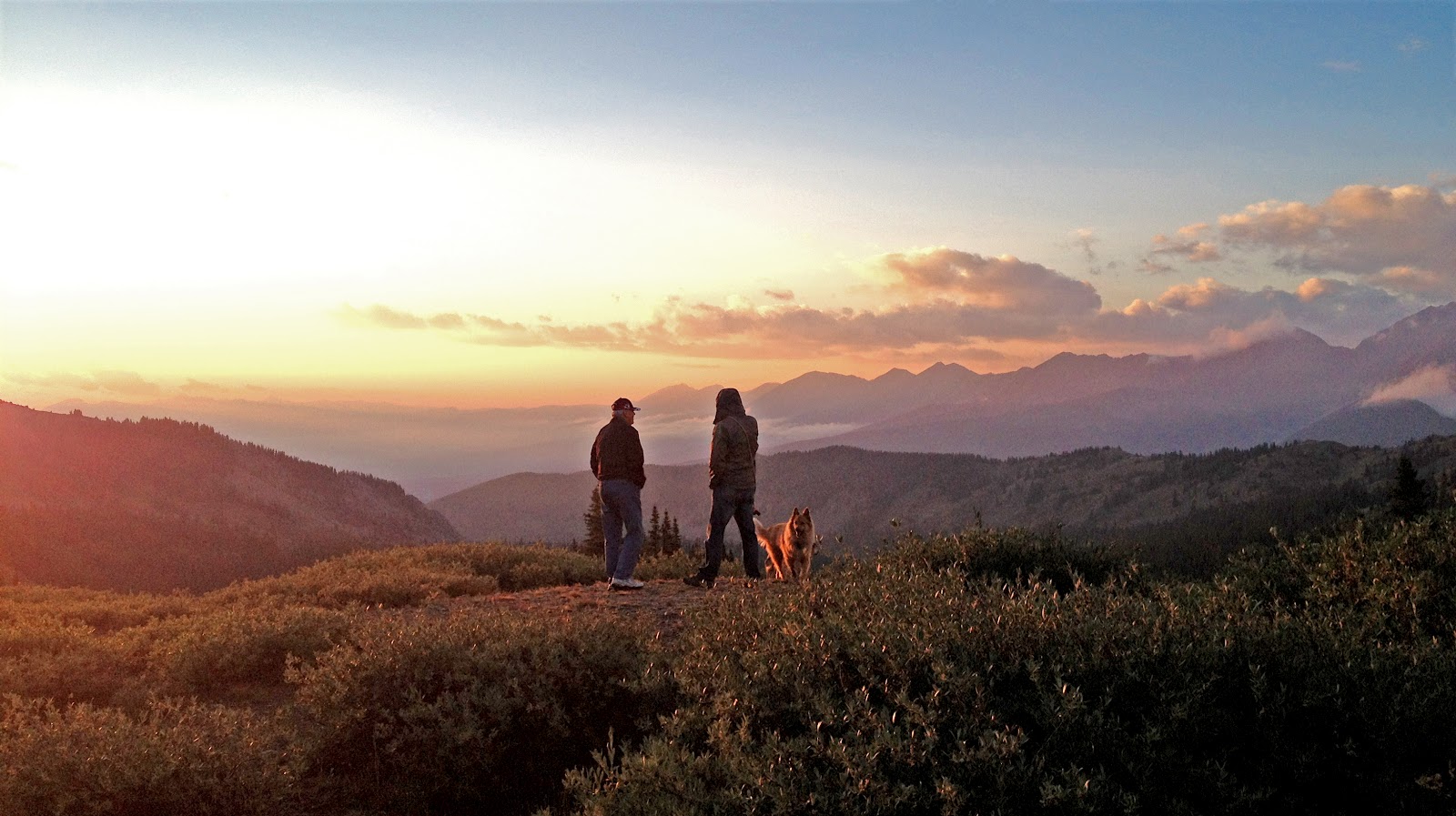
For ten days we explored Colorado and managed to not talk about cancer much at all, though I did find myself wanting to show my dad utterly beautiful things that I hoped would somehow flood into his psyche and provide a healing buffer. It's the best thing I could think to give him. So one night we drove up to Cottonwood Pass on top of the continental divide to watch the sunset. And it delivered.

I can easily recall a time when inter-generational tension kept family visits brief and polite. As a young man I would obsess about the imperfections of my family. The same was true for my wife Kae and her folks. On a car trip home after one beach vacation with her family, we had that conversation where you amaze yourself by identifying all the layers of dysfunction that somehow only you could see, but that mom and dad could not. We were pleased at our own insight and our resolve to live differently. After a hundred miles of working ourselves up, we decided we needed a good primal scream. So just as we came to the Sideling Hill Pass over the Allegheny Mountains, we rolled down our windows and stuck our heads out in the 70 mph wind and screamed ourselves silly. Ahead of us the road sloped downhill all the way back to our home in Chicago, where we couldn't wait to be. This primal scream became a tradition. We did it every year at that same pass. We'd do it even when we had an enjoyable trip, just because we liked traditions. Our kids found it confusing when they were little. As they got older they let us know we were being overly dramatic and embarrassing. Eventually we agreed and stopped doing it.

A half hour before it was time to drive my folks to the airport, my dad and I sat quietly together in the living room, both busy with our mobile devices. He was on his Nook, and I was texting a friend about an upcoming photo shoot. My mom walked in and said, "Put down those things and visit, we've only got a few minutes left!" My dad responded, "We've been here ten days. We're all visited-out." Which was true, so we all laughed, and then I drove them to the airport a little early.

After my folks left, Kae and I puttered around the house, cleaning up a little, adjusting to our home being just ours again; which was welcome, but also made us a tiny bit melancholy. A ray of late afternoon sun hit the kitchen counter and illuminated hundreds of fingerprints. Evidence of life, invisible from other angles. Twenty or thirty years from now (if we're lucky), it will be our kids worrying about us, making plans, stressing out, feeling sandwiched. And as they see us beginning to fade, it will feel unfair, and it will seem absurd, as it should. I looked across the room at Kae and asked if she wanted me to make a margarita. The sunlight on the counter was now on her. Tiny blond hairs on her arms gave her a halo.  "Why does any of this have to end?" I said.
And she knew exactly what I meant.